Yesterday, we described what the emergency protection orders did to our lives. Today, we examine the screenshots used to support them.
On October 20, 2025, a demand letter sought $22,605.28 and threatened our removal from the property where we operated Silver Creek Adult Family Home. On October 21, Jun and Aileen Capinpin sought domestic violence protection orders against Annie and me. Temporary orders were entered ex parte—before we had the opportunity to answer their presentation at a contested hearing.
We had to obey the restrictions while preparing our defense and continuing to run a care home. The petitions were allegations. The restrictions were already real.
The October 21 declaration filed against Annie included seven screenshot selections across four pages. Several expressly identified me as the speaker. Others contained Annie’s words or comments from both of us. Those distinctions matter.
The messages below were among the materials submitted in support of those petitions. At the November 4 hearing, their meaning was disputed again. Their attorney characterized the 911 language as directly threatening. The court ultimately credited the explanation that it had been taken out of context.
This is the part of the story that deserves a closer look: how fragments of a family and property dispute were presented as reasons to fear us—and what a reader sees when the missing language and dates are restored.
Continue from October 21: One Day, a $22,605 Demand. The Next, Protection Orders. →
The restrictions came before our answer
The temporary orders prohibited direct, indirect and third-party contact with Jun, Aileen and their listed children, subject to the exception for service of court documents. They imposed a 1,000-foot stay-away restriction covering specified people and places, including the protected persons’ workplaces. The forms warned that violations could result in arrest, criminal charges or contempt.
The initial order said that, based on the petition, testimony and case record, it appeared there was a basis for protection. It directed issuance without notice to avoid “serious immediate harm or irreparable injury.” Those were preliminary findings made on the petitioners’ presentation, before we could present our response.
The initial order also addressed allegations about driving past the Capinpins’ residence and appearing at their daughter’s birthday celebration. The handwritten findings in Annie’s order emphasized those events. We do not claim the screenshots were the only grounds for the temporary orders.
Read the initial hearing record and the handwritten findings
The October 21 clerk’s minutes record that Jun and Aileen appeared, were sworn and provided testimony. The court granted a temporary order and set the contested hearing for November 4. The order’s attendance section shows the protected person present and no appearance by the restrained person.
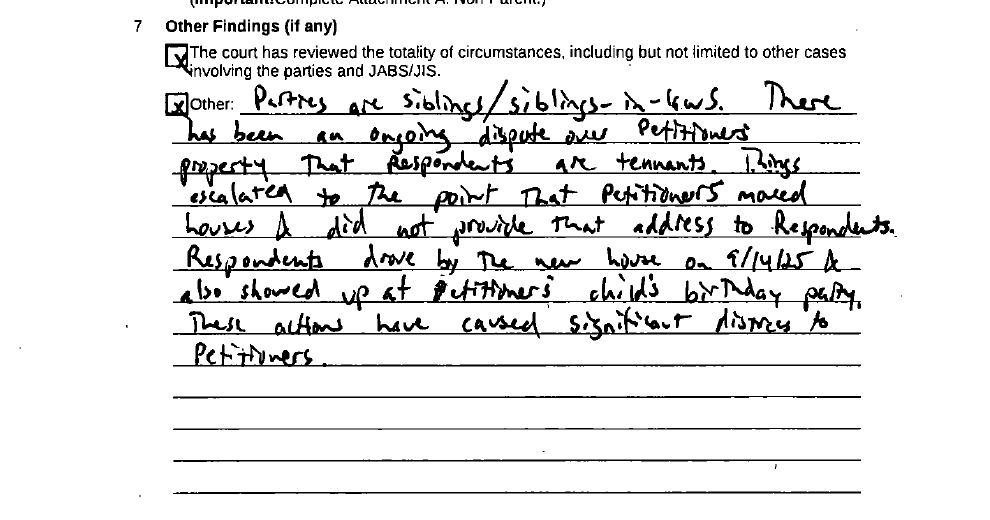
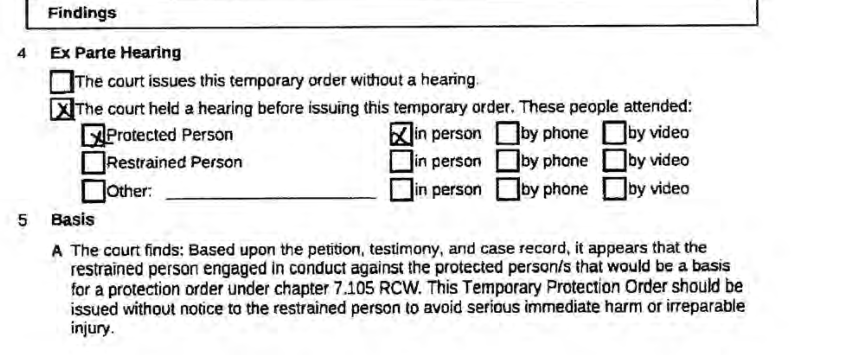
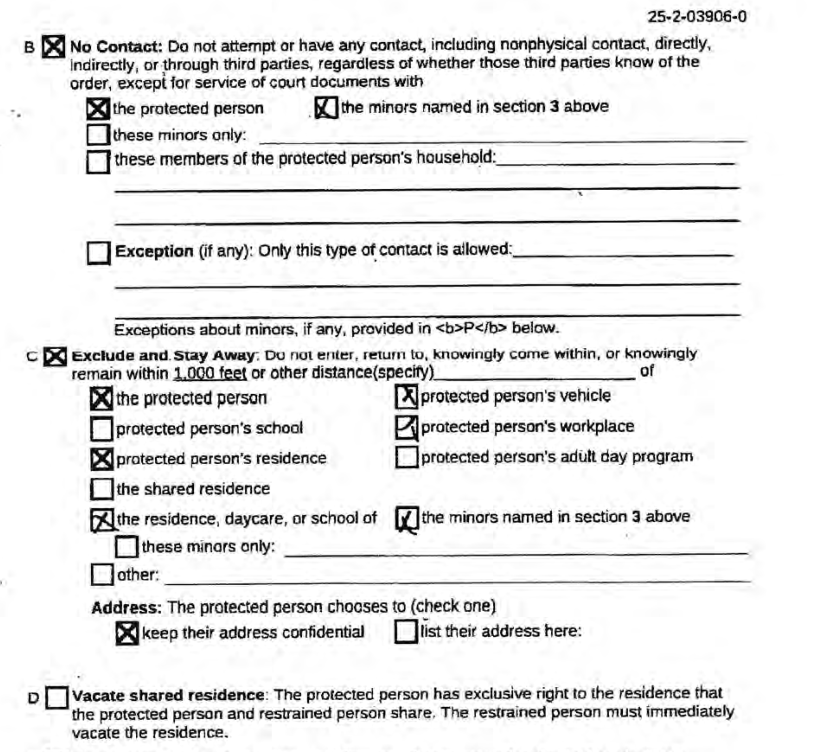
For us, the workplace restriction had a practical consequence: Jun and Aileen worked at Good Samaritan Hospital, a major potential referral source for our care home. We avoided going there until the November 4 dismissal while actively looking for residents. That is our account of how we adjusted our operations to comply with the orders.
Silver Creek was an operating adult family home. Residents depended on care around the clock. Annie and I still had to manage staffing, referrals and daily responsibilities while navigating restrictions and preparing a court response. The orders did not close the business or remove us from Silver Creek. They added an immediate burden to the people responsible for keeping it running.
In seeking protection, the petition linked the anticipated property litigation to a feared response:
“We are deeply concerned that this pending legal action will provoke retaliation given their prior behavior.”
That was their stated concern. Their selected messages were part of the account they offered to give that concern substance. The October filings placed screenshots under the heading “harassing, threatening, and intimidating messages.”
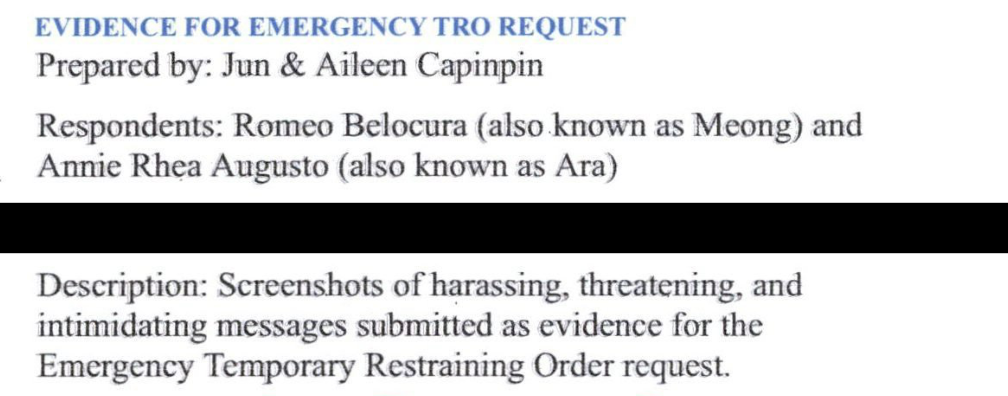
The label supplied a meaning before the reader had the conversation. What follows puts that meaning to the test.
1. The 911 exchange: a warning about safety presented as a threat
July 18, 2025 · Family Messenger conversation
How it was presented
Our 911 comments were submitted under the threatening-message heading. At the November 4 hearing, the supplied working transcript records their attorney calling the language “directly threatening” and saying it was sent to instill fear.
What the wider record shows
Annie had raised an allegation of earlier violence, and Jun asked for evidence. We say the later 911 comments were about getting help if the danger Annie described arose. The messages establish that she raised the allegation. Whether an assault occurred remains unresolved.
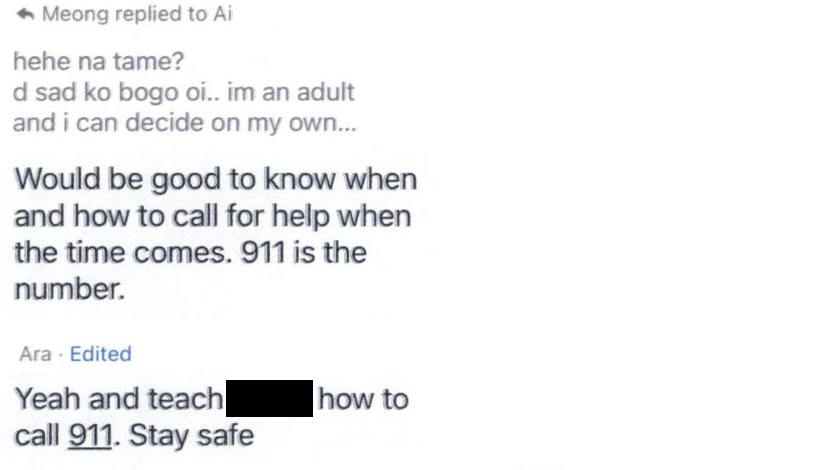
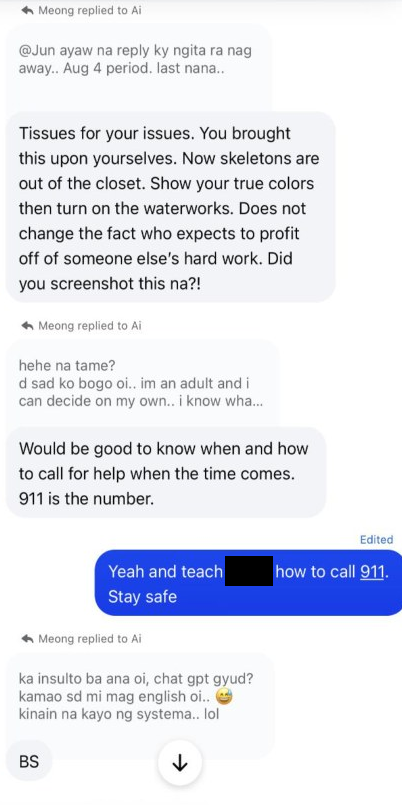
Before “911”: legal warnings, screenshots and a safety allegation
The discussion did not begin with our emergency-call comments. Earlier that day, Jun repeatedly invoked legal consequences and evidence while family members challenged Jun and Aileen’s account of the property dispute. At 5:34 AM he warned that false or baseless claims might be used against the speaker and said they would not hesitate to pursue every available legal remedy. At 5:51 AM, he urged a family member to consult a lawyer and said everything was documented with screenshots.
At 7:13 AM, I objected that Jun and Aileen were threatening lawsuits against people with differing opinions. Jun rejected that characterization: they were holding people accountable, he said, not intimidating them. Both positions are in the conversation.
Read the legal warnings and the family’s responses
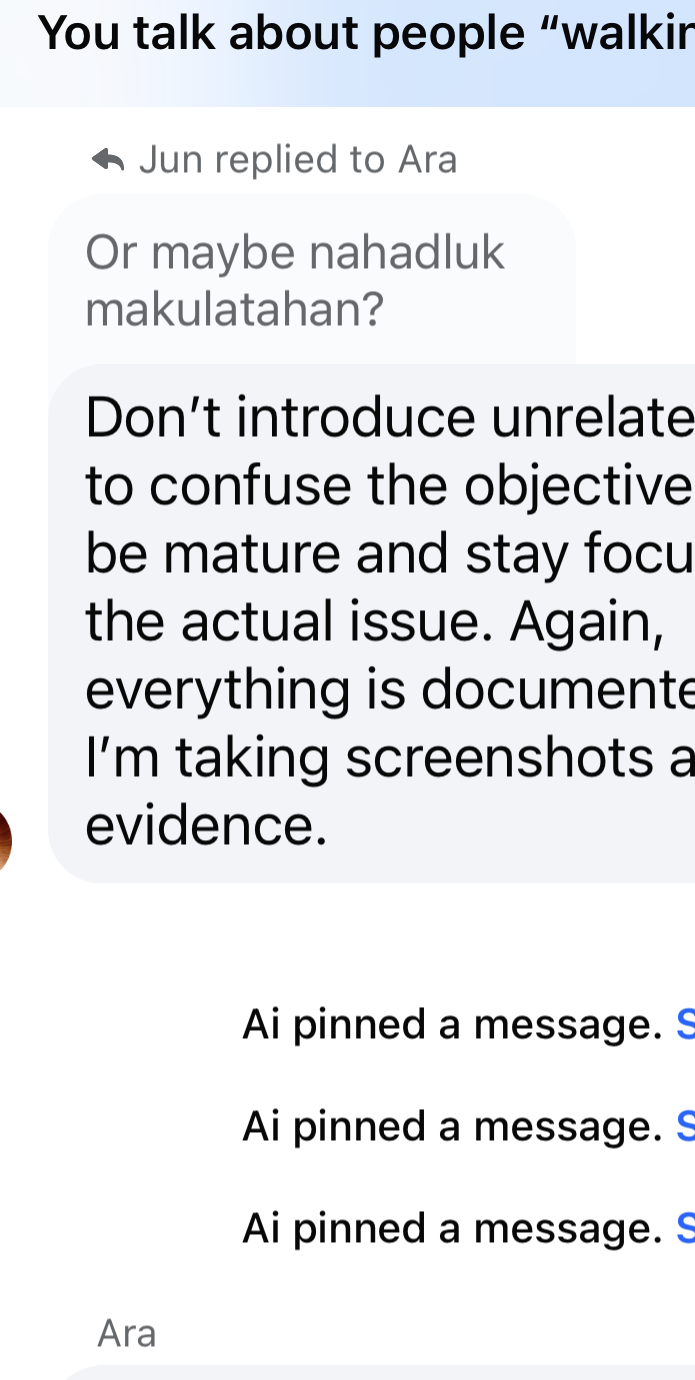
Jun’s request for evidence and Annie’s allegation are shown together in the source image. The fuller dated exchange follows.
Read the fuller morning exchange and the earlier message Annie relied on
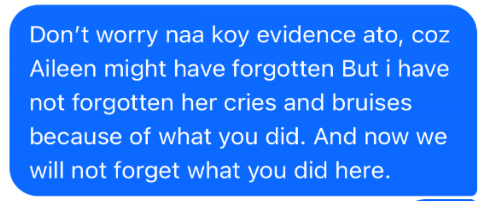
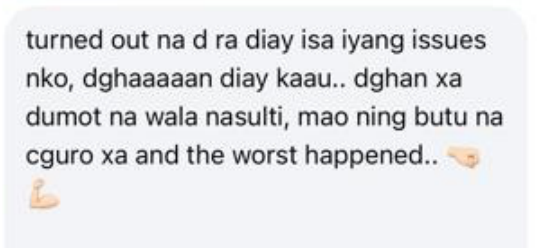
The supplied annotated packet also reproduces an older message attributed to Aileen saying “the worst happened.” The packet labels it June 2018, but the date is not visible in the crop. The words alone do not specify an assault. It is part of the history Annie says informed her concern, rather than independent proof of an assault.
Aileen’s reply—and the emergency-call comments that followed
That evening, Annie again referred to Aileen being “tamed.” At 10:01:12 PM, Aileen answered:
“hehe na tame? d sad ko bogo oi.. im an adult and i can decide on my own.. i know whats right and wrong.. lol 🤣”
The Cebuano opening means, in context, “Tamed? I’m not stupid either.” Aileen asserted her independence and judgment. Her reply does not resolve the earlier allegation.
At 10:22:08 PM, I wrote:
“Would be good to know when and how to call for help when the time comes. 911 is the number.”
Annie followed about sixteen seconds later, telling Aileen to teach her daughter to call 911 and ending “Stay safe.” Annie’s explanation is that, with the family relationship breaking down, she could no longer be there for her sister as before. Her daughter needed to know how to get help if the feared situation arose. In her later hearing response, the working transcript records Annie explaining: “I can no longer keep my sister safe.”
The surrounding exchange was hostile. My “Tissues for your issues” message came before 911, and “BS” followed. Those words remain visible in the expanded screenshot. The safety explanation must be assessed alongside that hostility, rather than against an artificially calm version of the conversation.
Read the dated evening entries
The screenshot marks Annie’s message as edited and includes “how to call”; the recovered JSON reads “Yeah and teach [child’s name redacted] call 911. Stay safe.” The sources do not establish when the edit occurred. July times shown here are Pacific Daylight Time.
Calling 911 can mean seeking protection from harm. Presenting the reference as a threat by the people who said it changes who is supposedly in danger—and who supposedly poses it. That was the central dispute. The court credited the context explanation.
2. “Goodbye forever”: the missing farewell
July 18, 2025 · Later the same evening
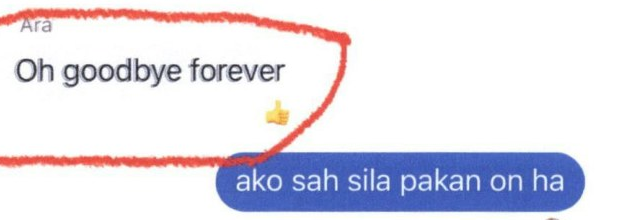
“Oh goodbye forever” was another selection included under the October threatening-message heading. Isolated from its lead-in, it can sound ominous. The restored exchange shows Jun’s own farewell immediately before Annie’s answer:
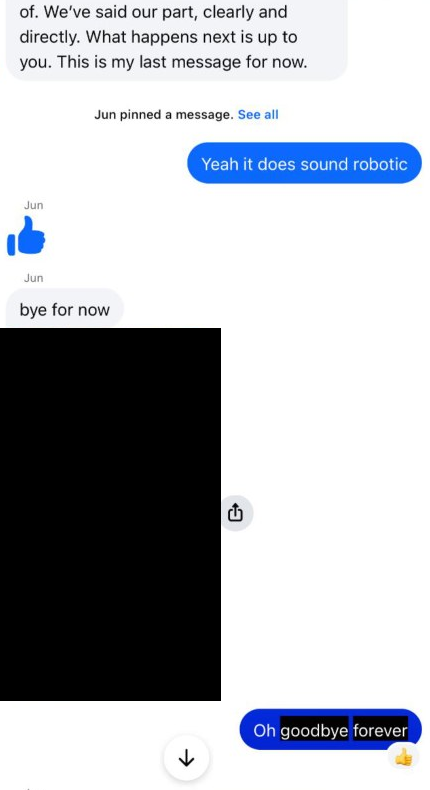
Jun wrote “bye for now” at 11:05:47 PM. A photo followed. Annie answered “Oh goodbye forever” at 11:06:05 PM—about eighteen seconds after Jun’s farewell. Jun then wrote that he would feed them first. The children’s photograph is fully masked in the image above.
Annie explains her words as ending the relationship with Jun. The preceding farewell supports that reading. It was also about 44 minutes after the 911 reply, not its immediate next message.
“Goodbye forever” is still blunt. But taking away “bye for now” takes away the words she was answering. Readers deciding whether this was a threat should have both.
3. “You better sign”: the missing condition and email
February 19–20, 2025 · Title transfer and financing
Jun’s October 21 petition against me states:
“On February 2025, we were coerced to sign a quitclaim deed for our property at [address redacted] and intimidated, harassed, bullied, and threatened after we refused to sign it.”
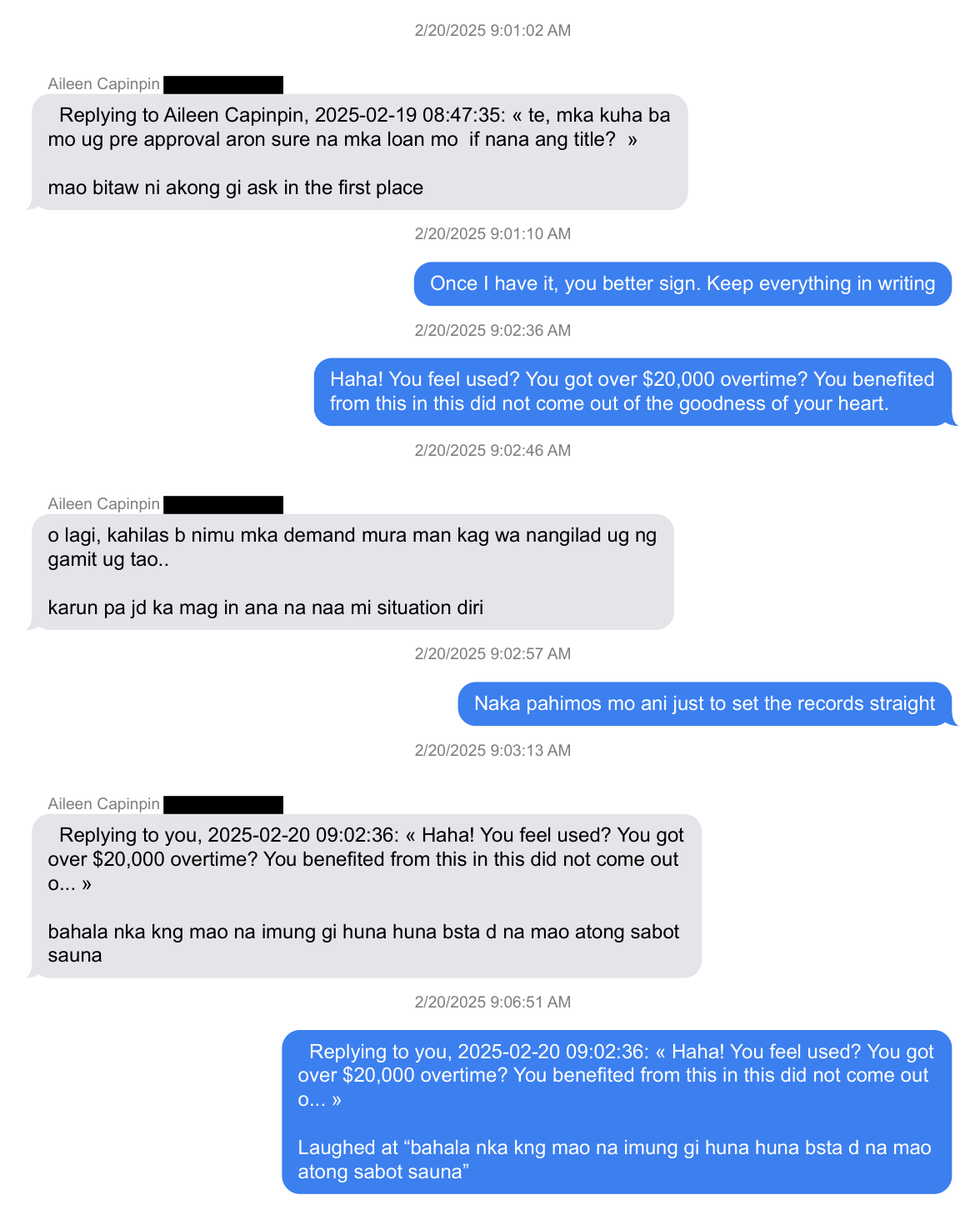
The petition against Annie similarly states, “they coerced and pressured us to sign a quitclaim deed,” followed by an allegation of refusal and harassment. The quoted “they” refers to Annie and me. The selected message reads: “Once I have it, you better sign. Keep everything in writing.”



“It” was the preapproval they had asked for
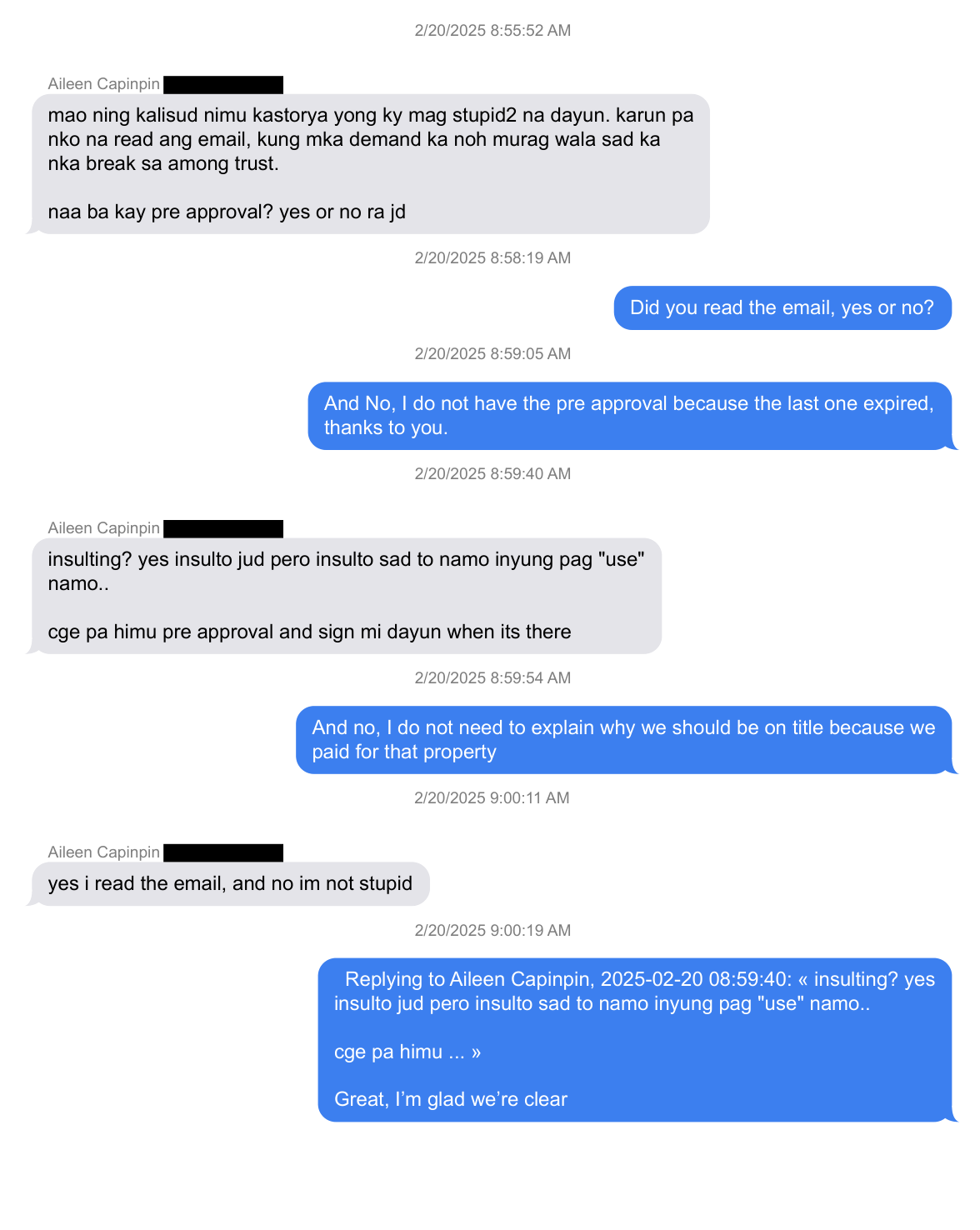
At 8:59:40 AM on February 20, Aileen wrote: “cge pa himu pre approval and sign mi dayun when its there.” In context: get the preapproval and we will sign immediately when it is there.
At 9:01:02 AM, she referred back to that request. Eight seconds later came my “Once I have it” reply. The selected words were a demand to follow through once the stated condition was satisfied. They were not detached from an explanation of what was to be signed or from a conditional willingness to sign.
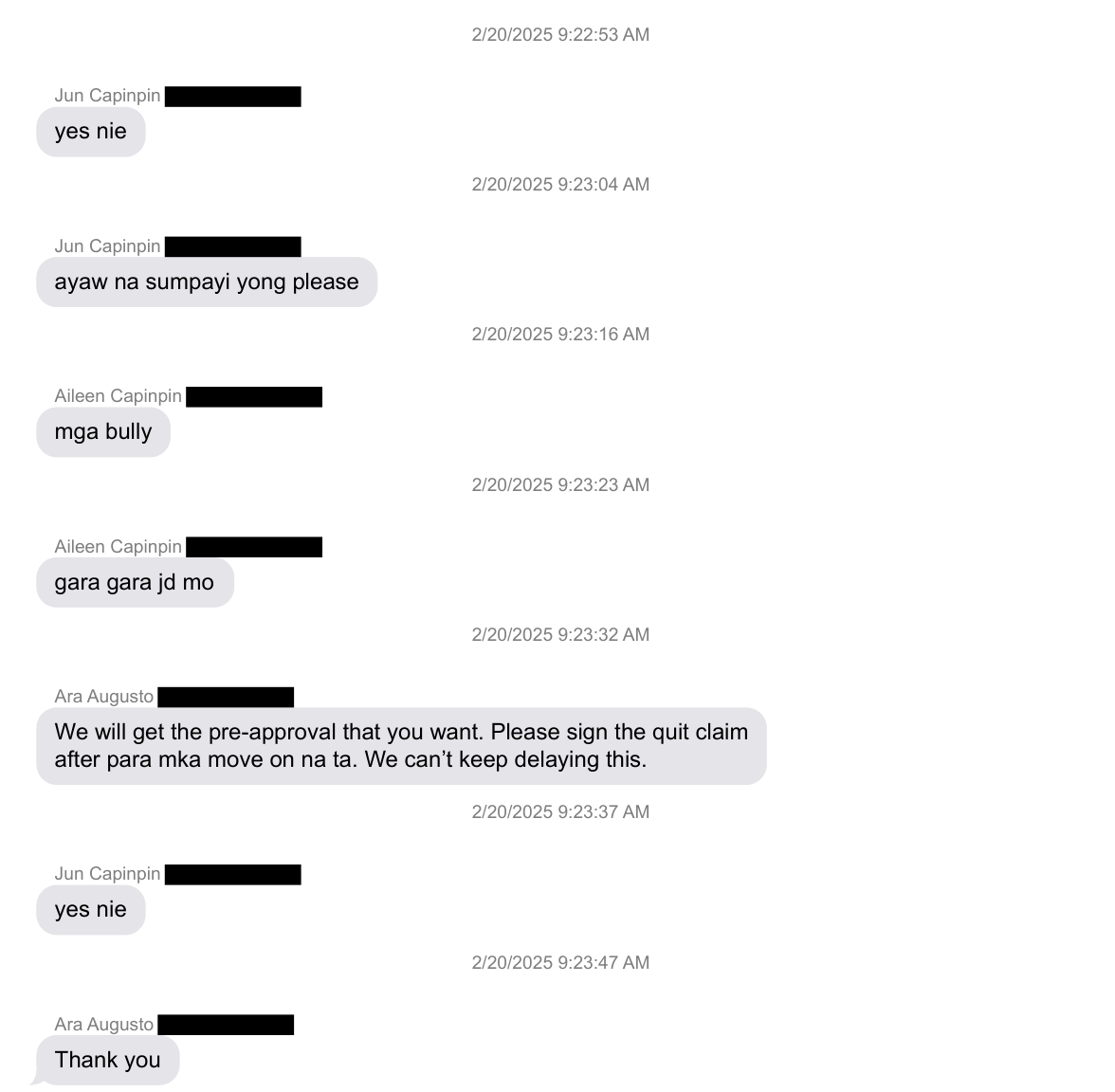
At 9:23:32 AM, Annie wrote: “We will get the pre-approval that you want. Please sign the quit claim after para mka move on na ta. We can’t keep delaying this.” Jun answered “yes nie” five seconds later.
Read the selected reply, continuing argument and Jun’s later answer
The other signing screenshot: the notary and another postponement
The declaration also included Jun’s February 20 request to postpone while he recovered from an injury and the family cared for their daughter. My reply insisted that a decision had already been made, that the notary could come to their house, and that I did not accept another delay. A handwritten note beside it described this as “pressuring us to sign the quitclaim.”
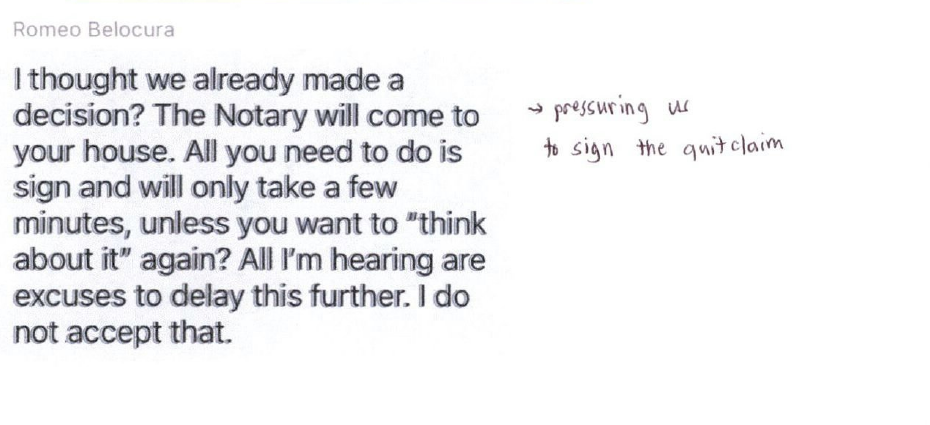
The pressure in my words is visible. So are the injury and family circumstances Jun identified. Readers should see both.
But the wider conversation also shows that the title-transfer process was already under discussion. Annie had offered to arrange an explanation of the paperwork. Aileen said we shared the same goal and requested preapproval. Later that morning, she said they would sign when it was provided.
Read Jun’s postponement request and Romeo’s reply
February 20, 2025 · Device export, PDF page 159; also shown in the filed declaration, PDF page 6. Original mixed Cebuano/English retained. The child’s name is replaced by a marked privacy omission.
Jun · 8:40:55 AM
nie, yong, pwede ato lang sah ni i postpone ha kay na injured pa man gud ko and nag focus pa mi krn sa pag recover, as well as c [child’s name omitted]… please…
Contextual English paraphrase: Jun asks to postpone while recovering from his injury and focusing on recovery and their child. This is a working paraphrase, not a certified translation.
Romeo · 8:47:16 AM
I thought we already made a decision? The Notary will come to your house. All you need to do is sign and will only take a few minutes, unless you want to “think about it” again? All I’m hearing are excuses to delay this further. I do not accept that.
The surrounding exchange does not erase my impatience. It identifies the transaction, the proposed steps, and the condition being negotiated. The screenshot captures an argument inside that process.
The email behind the argument
The two preserved outgoing emails, dated February 19–20, 2025 and addressed to Jun, Aileen and Annie, explain the transaction I was proposing. Their displayed times and the recovered February 20 Date header are distinguished in the source panels below.
My proposed sequence was to add Annie and me to title while Jun and Aileen remained on it; secure financing to pay off their loan; then have them transfer their remaining interest to us. I expressly acknowledged that their existing loan would remain in their names while our loan was being arranged.
“The loan will stay in your names in the meantime until our loan is finalized, then our lender will payoff your lender. Then you can then quit claim the property to just Annie and me (Romeo).”
Romeo’s February 19 email; original wording retained.
I wanted our investment and livelihood protected on title while we pursued financing. The longer email says why I was frustrated: I believed earlier preparations had been stopped, we were going back and forth again, and distrust was putting our investment at risk. I also objected to funding another down payment through a purchase-and-sale route.
“It is clear to me that you do not trust me, and the assumption that I’ll screw you over the title is not only upsetting but also damaging.”
Romeo’s February 20 email.
Those emails set out my proposal and my view of the dispute. They were not a lender’s guarantee of approval. The longer email also contains my own legal-action warning, discussion of insurance and the demand “This needs to happen now.” The complete outgoing bodies below preserve that pressure.
Read Romeo’s February 19 email — the proposed title and financing sequence
Read Romeo’s February 20 email — frustration, trust, transaction terms and legal-action warning
“Email,” “stupid” and “trust”: what the screenshot leaves unresolved
Aileen had asked for preapproval on February 19, before either email. Her concern was whether a loan could follow the title change. My answer was that they would stay on title until their loan was paid off. Those were different assurances.
At 8:54:10 AM on February 20, I wrote: “Did you read the email? Read again and see why you asking for assurances is irrelevant, insulting and stupid.” Aileen replied that she had only just read it, objected to “stupid,” said I was making demands as though I had not broken their trust, and asked whether I had preapproval: yes or no.
At 8:59:05 AM, I answered: “And No, I do not have the pre approval because the last one expired, thanks to you.” At 9:00:11 AM, Aileen wrote: “yes i read the email, and no im not stupid.”
Clarification: I describe the earlier lender communication as an assurance rather than a formal preapproval. My wording in that argument does not independently establish that a formal preapproval had been issued. The exchange does not establish a current formal approval either. Read the transfer-route explanation and source limits.
Follow the full dated exchange about the email, trust and preapproval
| February 20 chat time | Exact words or clearly marked excerpt | What the surrounding exchange adds |
|---|---|---|
| 8:47:16 AM · Romeo | “I thought we already made a decision?” and “All I’m hearing are excuses to delay this further. I do not accept that.” (excerpts) | I viewed another postponement as delay. Jun had cited injury and recovery; Aileen described household demands and denied reconsidering the plan. Those explanations remain part of the record. |
| 8:54:10 AM · Romeo | “Did you read the email? Read again and see why you asking for assurances is irrelevant, insulting and stupid” | The word “stupid” describes the request in this wording. It is insulting language; the surrounding record does not excuse it. |
| 8:55:40 AM · Romeo | “Adding us on title is ‘our’ assurance while our loan is in process. You will not be removed until we secure the loan.” (excerpt) | This restates the staged proposal in the email. The rest of this message blames Cora’s advice and mentions potentially suing her; that accusation is mine, not an established finding. |
| 8:55:52 AM · Aileen | “karun pa nko na read ang email” / “murag wala sad ka nka break sa among trust” / “naa ba kay pre approval? yes or no ra jd” (selected excerpts) | Working translation: she had only just read the email; she said I was making demands as though I had not broken their trust; she wanted a yes-or-no answer about preapproval. She also objected to my immediately using “stupid.” |
| 8:59:05 AM · Romeo | “And No, I do not have the pre approval because the last one expired, thanks to you.” | I said I lacked current preapproval. I describe the earlier communication as a lender assurance rather than formal preapproval; the quotation does not establish a prior formal approval. The blame at the end is my assertion. |
| 8:59:40 AM · Aileen | “cge pa himu pre approval and sign mi dayun when its there” (excerpt) | Working translation: get preapproval and we will sign immediately when it is there. Her preceding words in the same message object to how she believed we had “used” them. |
| 9:00:11 AM · Aileen | “yes i read the email, and no im not stupid” | Her response expressly connects reading the email to the insult. It should not be removed from a fair account of the argument. |
| 9:01:02–9:01:10 AM · Aileen, then Romeo | Aileen refers back to her preapproval request; I reply: “Once I have it, you better sign. Keep everything in writing.” | “It” refers to the preapproval. The demand follows a conditional willingness to sign, within an already hostile dispute over title, financing and trust. |
This was a hostile dispute over financing, title, control and trust. My language was forceful and insulting; their conditional willingness to sign does not prove that they felt no pressure. But an account that reduces it to their refusal and my demand leaves out the proposed transaction, the condition, the promised signature and Jun’s later affirmative response.
4. “Fuck you”: the reaction without the trigger
September 30, 2024 · Purchase-price discussion
I wrote “Fuck you!” I own those words. I wrote them on September 30, 2024, during a dispute over the price of the house. Sixteen seconds earlier, Jun had said they would overprice it. By the November 2025 hearing, the exchange was more than a year old. If those words were going to be used to show why we needed to be restrained, the court deserved to see when I said them and what I was answering.

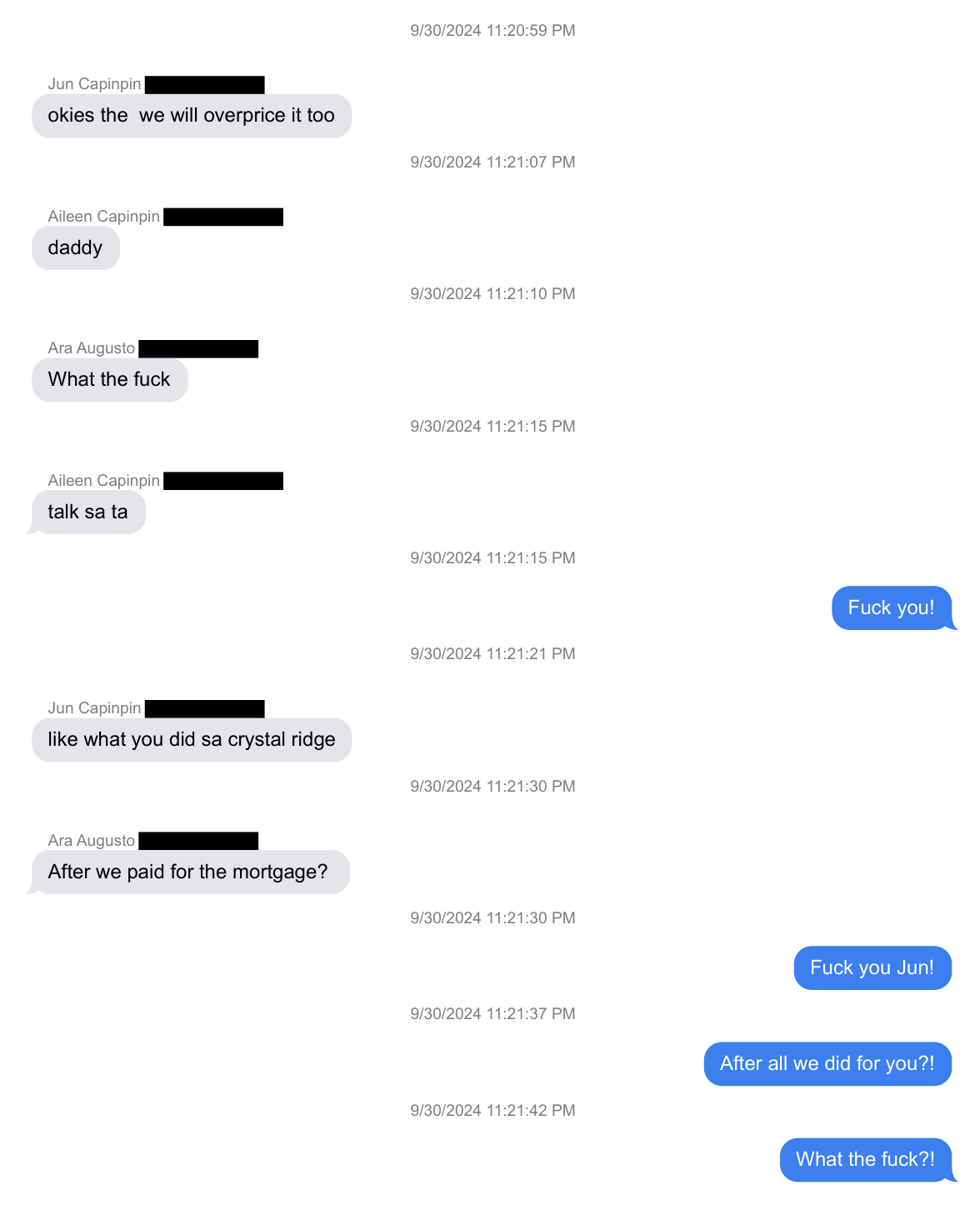
| Displayed time | Speaker | Message |
|---|---|---|
| 11:20:44 PM | Romeo | “We will buy it” |
| 11:20:59 PM | Jun | “okies the we will overprice it too” |
| 11:21:10 PM | Annie | “What the fuck” |
| 11:21:15 PM | Aileen | “talk sa ta” |
| 11:21:15 PM | Romeo | “Fuck you!” |
| 11:21:21 PM | Jun | “like what you did sa crystal ridge” |
| 11:21:30 PM | Annie | “After we paid for the mortgage?” |
At 11:20:44 PM, I wrote “We will buy it.” At 11:20:59 PM, Jun replied “okies the we will overprice it too.” My first profane reply followed at 11:21:15 PM.
I continued to swear. The expanded record shows it. We were arguing about buying the property and accounting for what we had spent. The submitted selection preserved the reaction and omitted Jun’s immediately preceding overpricing remark.
Read the preceding purchase discussion
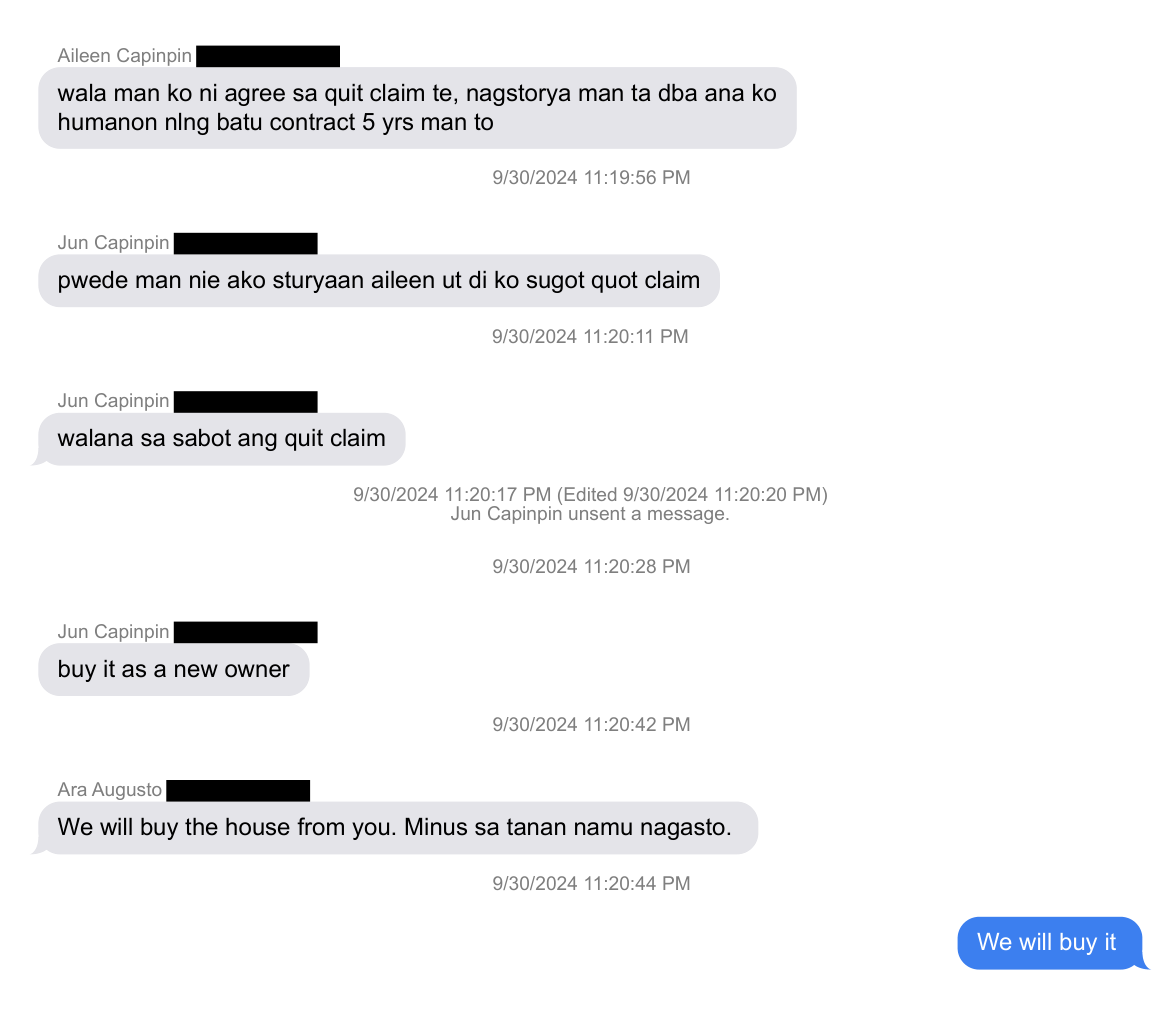
The date matters too. This exchange was 386 days old when the October 21 petitions were filed. It also predates the February 2025 refusal after which the petition against Annie says the harassment began. It cannot be an example of conduct that first occurred after that refusal.
Jun’s next message invoked a separate property-price dispute. The following morning, he apologized and said he had no plans to “mess up with your business.” Aileen later described the overpricing remark as spoken in anger and said she would not agree to it. Those qualifications belong beside the remark and our response. Read the apology and surrounding context →
Context does not make the profanity polite. It identifies the subject, the trigger and the date. Those are essential facts when old anger is offered as part of a case for emergency protection.
5. “You are not victims here”: the financial dispute behind the words
February 20, 2025 · The additional $1,000 monthly payment
How it was presented
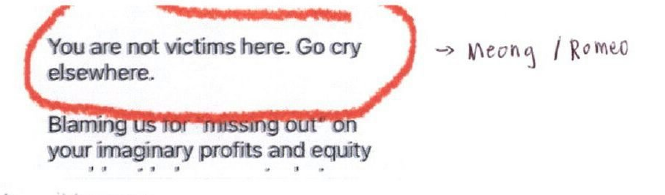
“You are not victims here. Go cry elsewhere.” Those were my words. They were circled in red in the declaration filed against Annie, with a handwritten identification: “Meong / Romeo.”
What the wider record shows
The selection also shows the beginning of my complaint about their claimed lost profits and equity. The financial subject was partly visible. The wider exchange identifies the additional monthly payment I had expressly said I would withdraw.
The $1,000 exchange earlier that day
| February 20, 2025 | Speaker | What the export records |
|---|---|---|
| 9:10:37 AM | Aileen | “also, 1k per month kaya kaau i overtime” |
| 9:12:30 AM | Romeo | “The audacity of telling me nga nagilad mi ninyo. Luoya gud ninyo? Well if $1k does not matter kay kaya raman diay, I am taking that away.” |
In context, Aileen said she could earn the $1,000 through overtime. I answered that if the amount mattered so little, I would take it away. I was expressly referring to stopping that additional monthly payment.
My longer message at 10:09:55 PM complained about financial losses and delays in resolving the property transaction. It ended:
“The reason you can afford to keep delaying this transaction is because doing so does not financially hurt you. That will soon change.”
That ending does not appear in their displayed selection. We include it here because restoring context also means showing language that can be read against us.
The earlier exchange identifies the payment I had said I would withdraw.
From my perspective, we continued taking the financial hit while the transaction remained unresolved, while they continued receiving the additional $1,000. I felt they could keep changing conditions without sharing the financial consequences of further delay. Stopping that payment was the consequence I intended.
We sometimes called that additional payment “rent.” We should be clear about that language rather than pretend it never appeared. The payment’s contractual treatment and any alleged arrears are separate questions requiring the agreements and payment record.
Here, the question is what my words meant. My explanation is supported by an express statement about withdrawing the $1,000 earlier that same day.
Read the dated payment exchange, including Jun’s objection about promises
Selected entries transcribed from the device export, PDF pages 163–165. Original mixed Cebuano/English retained. These are selected entries, not a complete transcript of the morning conversation.
Jun’s broader objections about promises and alleged bullying remain part of the exchange. We do not treat an absence of a separately identified payment demand in these selected entries as agreement to cancel a contractual obligation.
Read the complete evening message containing “You are not victims here”
Romeo · February 20, 2025 · 10:09:55 PM. Device export, PDF page 166. Complete message body; export footer and contact identifiers omitted.
So the reason you’re bitter and holding the house hostage is really because you’re blaming us for your lost “opportunity”? You’re probably wishing for us to fail because what you’re doing is sabotaging our finances right now, screwing with our plans and preventing us from getting successful so we can help the rest of your family.
You are only after what you can get for yourselves but don’t you see the bigger picture? Do you enjoy this? Seeing us running around trying to make sure we keep our finances together and keep things from falling apart. Do you see the damage you’re causing just to get back at us? You are hurting our business more than we hurt your sense of entitlement and your delusion of persecution.
You are not victims here. Go cry elsewhere.
Blaming us for “missing out” on your imaginary profits and equity would not help you get what you want. Your entitled and vindictive attitude is causing us to lose thousands a month - real money, compared to “potential” cash and equity you both are crying about.
Publicly you continue on with life as if nothing happened while you yap around behind our backs telling people how you got screwed because you now don’t qualify for “Zero percent down payment” (which by the way never existed - remember the $40k we paid?).
Like you said, “man up” and stop blaming others for things you cannot achieve. Don’t blame others. Blame your credit. Have you even considered that?
Are we blaming anyone for our failures? Are we blaming someone else if we can’t afford a bigger house or afford our expensive lifestyle? Do we blame others if I get denied a loan? Do I go around telling my friends and family that the reason I live in a house that I hate is because I got screwed (but actually make money from without lifting a finger), but continue to tell people that I never benefited from it. I am not responsible for your failures. You told me to “man up”, I can tell you the same.
The reason you can afford to keep delaying this transaction is because doing so does not financially hurt you. That will soon change.
The assertions and accusations in this message are Romeo’s words and views at the time; reproducing the message does not independently establish each assertion.
Read Aileen’s February 21 response about preapproval and the quitclaim
Aileen · February 21, 2025 · 1:44:25 PM. Device export, PDF page 167. The response is dated February 21, separately from Romeo’s February 20 message.
ikaw ang nag delusion.
send pre approval mao ra na among gi ask, kung nag lisud kag secure ana wa nakoy mabuhat ana
imung pre approval ang nag delay, dili kami
syempre maniguardo mi na ma purchase nimu befor mi mu sign anang quit claim, unsaon palang na nimu unya na naa pas among name ang mortgage
cge gara gara pa diha ug file ug kaso, and quit claim will not be in the options, cge pa
Contextual English paraphrase: Aileen blamed the delay on preapproval, said they wanted assurance before signing while the mortgage remained in their names, and said continuing toward litigation would take quitclaim out of the options. This paraphrase is not a certified translation.
The language was angry and personal. Readers can assess it with the financial reference restored.
6. “We demand”: applying their own demand for proof
July 18–22, 2025 · Purchase deadlines, documents and legal warnings
How it was presented
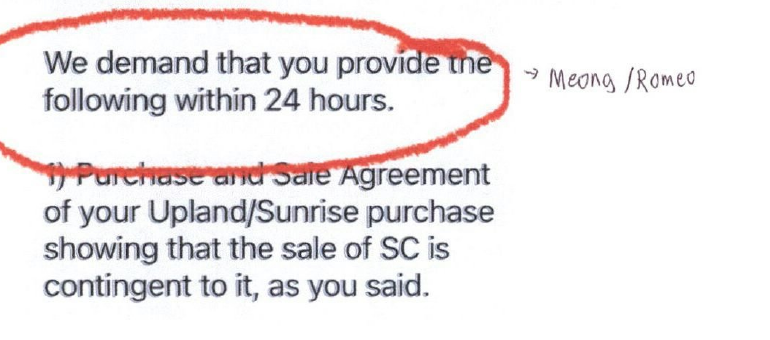
The final screenshot in the declaration circled: “We demand that you provide the following within 24 hours.” It appeared under the same threatening-message heading.
What the wider record shows
The screenshot itself shows the first request: the purchase agreement supporting the asserted connection between their Upland/Sunrise purchase and Silver Creek. The subject was visible. I was demanding transaction documents.
Why I asked
Earlier in the family discussion, Jun had invoked screenshots, evidence, lawyers and legal consequences when relatives challenged their account. The July 18 chronology above preserves those exchanges.
Meanwhile, Jun and Aileen were saying their opportunity to buy another house depended on completing the Silver Creek transaction. They invoked that purchase and its financing to explain the urgency they were placing on us.
We already had a signed purchase-and-sale agreement. On July 18, the parties signed an addendum setting closing for August 4 or sooner. Their separate purchase and financing claims were additional representations I wanted substantiated.
If those circumstances were being used to press us, I wanted to see the documents supporting them.
My July 20 communication requested:
- The purchase agreement supporting the claimed contingency.
- Loan documentation supporting the asserted 4.9% rate and its claimed loss if Silver Creek did not close by August 4.
- Clarification of what they said would happen if we did not close by that date.
What “a taste of your own medicine” meant
I meant applying their own demand for evidence and legal accountability to their representations.
They had asked others to support their claims. I was asking them to support theirs.
My wording was aggressive. The complete communication includes an attorney warning, accusations of bad faith, and a demand for a response within 24 hours. The demand itself did not establish a right to compel production on that timetable.
But the documents requested—and the explanation immediately surrounding the phrase—identify the accountability I was talking about.
Read the complete July 20 “Provide Proof” communication
Romeo to Jun and Aileen, copied to Annie · July 20, 2025 · 12:40 AM as displayed in the email record. Complete body; signature, contact information and boilerplate omitted. This companion communication supplies the full numbered requests and the “your own medicine” explanation. It is distinct from the cropped Messenger image submitted with the declaration.
Jun and Aileen,
If you do not provide your PSA, Loan Estimate/Agreement and not clarify what will happen if we do not close by 8/4, you will have to answer to our attorney.
Lying about your circumstances as a tool of coercion shows bad faith and malicious intent. If we can prove that you are negotiating in bad faith and making false statements, you will have a taste of your own medicine. You are the ones making the claims so the burden of proof is on you. Prove your claims and provide evidence just like what Jun has said so many times. If any of what you’re claiming is untrue, you are liable because we have a fully executed Purchase and Sale Agreement and you cannot lie, conceal, mislead or claim falsehoods.
We demand that you provide the following within 24 hours.
- Purchase and Sale Agreement of your Upland/Sunrise purchase showing that the sale of SC is contingent to it, as you said.
- Your loan estimate/agreement showing that you’re being offered 4.9% interest and that you will lose it if we do not close the SC transaction by 8/4.
- Clarify what you meant in your vague statement about what will happen if we do not close SC by 8/4. State your intentions.
These are not requests. We demand that you produce these documents to back up your claims. It has been 24 hours since these were requested. Failure to respond to this will be construed as refusal to cooperate and I will use all legal remedies that you’re threatening us with and make sure that you are held accountable if you are being dishonest and I am not afraid nor would I hesitate to hold you two accountable for all the threats, intimidation and coercion if you do not comply.
This serves as my formal notice.
These are the sender’s allegations and asserted legal positions, not judicial findings. A request for a document does not establish that the representation was false or that the document had to be produced on the requested timetable.
What came back
On July 22, their attorney sent a cease-and-desist email. He characterized my messages as threatening and harassing, warned of a restraining order or other litigation, and directed purchase-related inquiries through his office.
In that same email, he expressly refused the requested separate purchase agreement and loan information, stating that we were not entitled to them and that they were unnecessary to complete the Silver Creek purchase.
That was his position. It did not substantiate the representations I had asked to verify.
When our lawyer later sought particulars about the allegedly objectionable messages, their attorney’s August 4 response declined an “analysis and recitation” of messages he said I could show my lawyer. He referred generally to cursing, vulgarity and insults. That response did not identify particular passages or explain them individually.
Read the July 22 refusal and August 4 response
July 22, 2025 · 3:51 PM · their attorney to Romeo, copied to Annie
Complete substantive body. Header contacts, signature and boilerplate omitted. Opposing counsel’s statements are reproduced as his position.
Good Afternoon,
This email is to serve as your formal notification to cease all communication and contact with my clients, Jun and Aileen Capinpin. I have reviewed your text messages to my clients and they rise to the level of threatening and harassing and must cease immediately. Failure to do so may subject you to a restraining order or other litigation. To the extent communications are needed to complete the purchase and sale of the real property located at [property address omitted], please send such inquires directly to my office.
Please note that your request for my client’s separate purchase agreement and loan information shall not be provided. You are not entitled to such information and it is not required to complete the purchase and sale of the real property.
If you obtain legal counsel of your own, please provide their contact information and I will communicate directly with them.
August 4, 2025 · 10:26 AM · their attorney’s response to our lawyer
Substantive body of the opposing counsel response shown in ADULT FB MESSENGER 7, PDF page 24. The underlying request is summarized above; no private attorney-client advice is reproduced.
Rhia,
I’m not inclined to spend my client’s dollars on an analysis and recitation of text messages that your client can show to you. Cursing, vulgarity, and insults are generally considered harassment.
At this time, all communication is being requested to go through the parties’ respective attorneys.
The July email refused transaction documents; the August response declined to analyze and recite the messages. Those are separate responses. We do not claim that these exchanges prove no screenshots or messages were ever produced later.
The sequence matters: claims about another purchase and its financing; my demand for supporting documents; a refusal to provide them coupled with a harassment accusation; and, later, the use of “We demand” in the emergency-protection exhibit packet.
Readers should see the words I used. They should also see what I demanded, why I demanded it, and how the request was answered.
What the court found after hearing both sides
On November 4, 2025, after the parties had the opportunity to be heard, the court denied the petitions. Its written addendum found no active threat of violence and no pattern of unlawful conduct warranting an order. It described heated communications arising from a property and contract dispute.
On the 911 statement specifically, the court found the respondent’s out-of-context explanation credible. It also could not find that a preponderance supported a pattern of unlawful contact or a clear showing of harm or emotional distress from the alleged actions.
Read the complete court addendum, including the contact warning
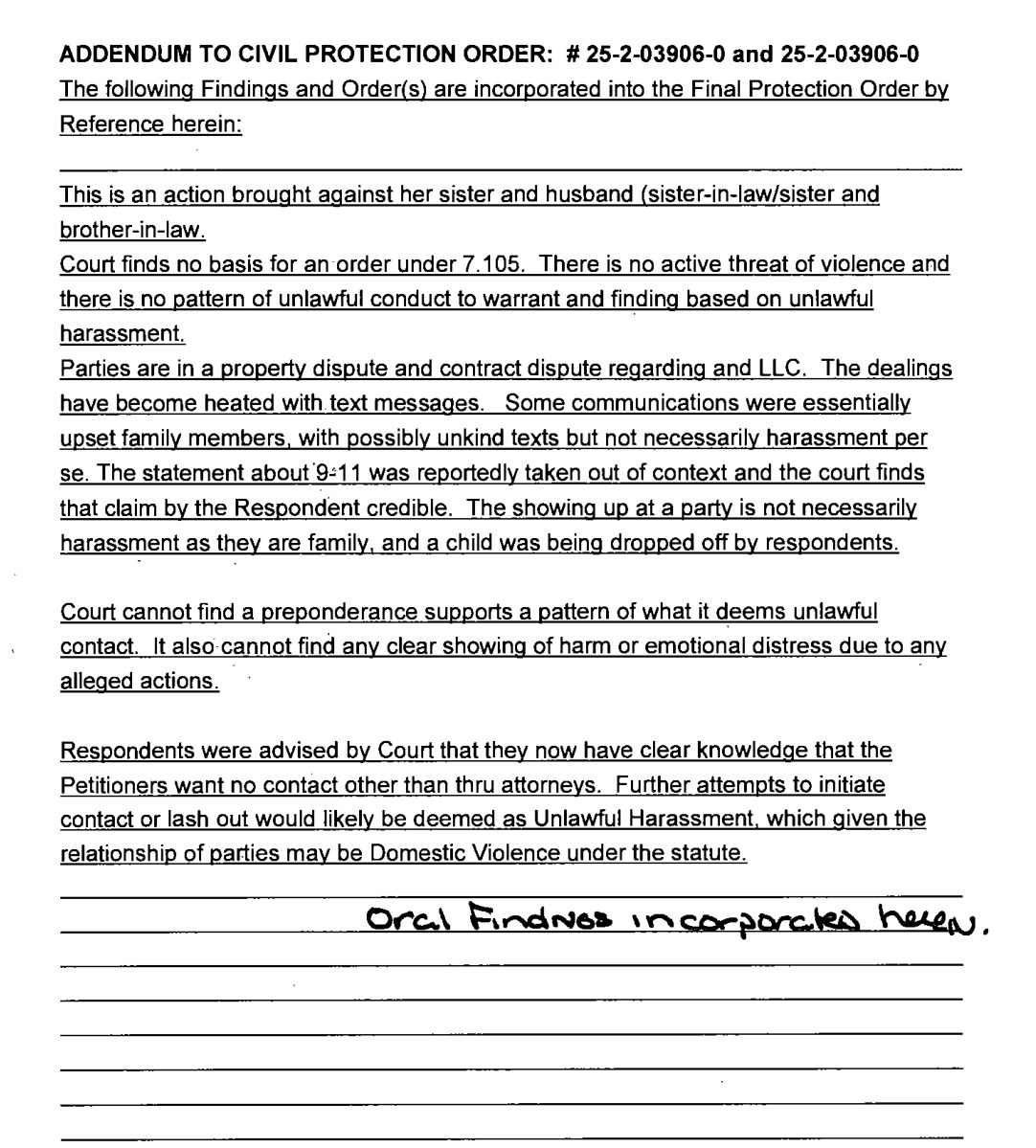
The court also gave a clear warning: the petitioners wanted no contact except through attorneys, and further attempts to initiate contact or lash out would likely be deemed unlawful harassment. That warning is part of the outcome and remains in the full addendum above.
The ruling did not declare every allegation fabricated or decide every disputed event. It did reject the requested protection orders. The restrictions and the work required to respond had already happened.
The missing context had consequences
The screenshots recorded words we used. Our criticism concerns the meaning assigned to those selections—and the context needed to evaluate it.
Across the seven selections:
- The 911 exchange concerned obtaining emergency help, according to our explanation, which the court later found credible.
- “Goodbye forever” answered Jun’s own farewell.
- The signing exchanges arose inside a disputed title-transfer process involving paperwork, financing and a requested preapproval.
- The profanity followed Jun’s immediately preceding overpricing remark.
- “You are not victims here” came from a financial argument that included my express statement about withdrawing the additional $1,000 payment.
- “We demand” introduced requests for documents supporting representations made in the property transaction.
These comparisons do not all establish the same thing. Some restore missing words. Others identify a condition, a financial reference, a date or the subject of a demand. The court made an express credibility finding about the 911 explanation. We do not extend that finding to every screenshot.
Most selected images do not display the message dates; the notary screenshot retains a February 20 date. We do not claim every timestamp was deliberately removed. Dates come from the underlying exports where those records supply them.
We consider the selected presentation misleading where the omitted facts materially change how the words can reasonably be understood.
We also preserve what is unfavorable to us: the profanity, insults, impatient demands and harsh financial language. A complete comparison should withstand those words being read too.
The initial orders addressed other allegations as well. The screenshots were part of the presentation, and the people seeking emergency restrictions were responsible for the account they submitted.
By the time we could answer at the contested hearing, we had already spent days living around the orders while keeping a care home running. The later denial mattered. So does what it took to get there.
Read the screenshot. Then read what came before it, what came after it, and when it was actually sent. The meaning should survive the full conversation.
Read the broader hearing account and court findings → · More articles & updates →
Sources
The comparisons use the October 21 petitions and joint declaration, the November 4 written orders, the supplied hearing transcript, dated device-message exports, archived original emails and the preserved Meta chat export. Images are cropped for readability and privacy; children’s identities, contact details and the property address in the petition excerpts are masked.
Source locations, dates and transcript qualifications
- October filings: joint declaration in Annie’s case, PDF pages 4–6; corresponding screenshots in Romeo’s 36-page service packet, PDF pages 31 and 33–34. The quitclaim allegations are in section 17: service-packet page 22 and Annie-petition page 8.
- Restrictions: the October 21 temporary orders. The hospital-referral effect is our account of how we complied, rather than a separate court finding about business loss. Romeo’s return of service records October 24.
- September and February messages: four-person iMazing export, pages 107–108 and 158–165. Displayed message times have no stated timezone. The English explanations of Cebuano passages are working translations. Ara is Annie; outgoing messages are Romeo’s.
- February emails: original archived EMLs titled “Fw: Romeo/Capinpin Quit Claim.” Header dates convert to February 19, 9:30:49 PM PST and February 20, 12:22:36 AM PST. The chat confirms that Aileen read “the email” but does not identify which version. Only Romeo’s outgoing body is reproduced; contacts, signatures and earlier forwarded correspondence are omitted, with third-party names redacted where present.
- July messages: preserved Meta-export-format JSON for “Adults only Augusto fam,” containing 661 entries. Retrieved from the existing export archive, rather than freshly downloaded from a Facebook account. July timestamps are converted to Pacific Daylight Time. Selected transcriptions omit intervening entries and are not screenshots of the Meta interface.
- July images: supplied annotated conversation, pages 1–3, and separately retrieved IMG_5778(2).PNG. The JSON references photo attachments whose original files were not recovered. The older “worst happened” screenshot has an annotation-derived date, not a verified native timestamp.
- November 4 hearing: supplied working transcript, page 2 for their attorney’s characterization and page 6 for Annie’s explanation. It is not certified. The written orders, including the addendum on page 10, are the basis for the court findings quoted here.
The source selections retain hostile language and opposing explanations. The court’s context finding concerns 911; it is not extended into a finding that every other screenshot or allegation was false.
Additional source locations: joint declaration in Annie’s case (cause 25-2-03908-6), PDF page 4 upper (“victims”), page 4 lower (“goodbye”), page 5 upper (911), page 5 lower (conditional signing), page 6 upper (profanity), page 6 lower (notary/postponement), and page 7 (document demand). The filing cover is dated October 21, 2025. The inspected seven-page copies carry the same seven subjects; their pagination is used here.
Payment context: device export, pages 163–167; February 20 morning entries and 10:09:55 PM message, followed by Aileen’s February 21 reply. The financial interpretation is Romeo’s explanation, supported by the earlier express payment-withdrawal statement; it is not a ruling on the payment obligation.
July document requests: July 20 “Provide Proof” email, displayed 12:40 AM; July 18 signed closing-date addendum setting August 4 or sooner. The companion email and cropped Messenger selection are distinct records. The claimed contingency and rate are attributed representations, not findings that those claims were true or false.
Counsel responses: July 22 cease-and-desist email, 3:51 PM; August 4 opposing-counsel response, displayed 10:26 AM, reproduced in ADULT FB MESSENGER 7, page 24. The article does not reproduce private attorney-client advice or settlement negotiations.
Procedural sources: October 21 clerk’s minutes, pages 1–2; Annie’s temporary order, pages 2–4. The blank pending service form supplies no completed service details. A file named as an October 21 their attorney service declaration actually records October 30 service and an October 31 filing; it is excluded from the initial-filing account. No later alleged-violation screenshots are analyzed here.