THE TITLE TRAP / THE FULLER CASE HISTORY
One story. The longer record behind it.
A reader-first investigation is the beginning, not the whole archive. This companion restores the wider chronology, contradictory documents, competing explanations and unresolved questions that U8 preserved for careful source review.
This is a qualified advocacy account, not a court finding. It uses fourteen selected source excerpts reviewed for privacy and a source register from U8; uncleared U8 PDFs and images are not attached.
THE DEEPER RECORD / READ BY QUESTION
The difficult details belong beside our argument.
The preserved extended guide supplies context that a short account cannot carry. These sections integrate its usable narrative, update the newer payment and filing corrections, and leave restricted source material outside the publication.
The ownership complaint was prepared December 26 and filed December 29, 2025, as the later-supplied receipt and docket establish. Earlier preparation-date references are not substituted for the filing date. The July 23, 2026 recorded conveyance remains the negotiated purchase endpoint.
01 / FRAME THE DISPUTE
A house held in two names. A project discussed by four.
The recorded deed identified Jun and Aileen Capinpin as the owners for years. That is a material starting fact. It is not the whole story of how the house was financed, maintained and operated as Silver Creek Adult Family Home.
Its intended use was known from the start. The January pre-closing discussions concerned the planned four-person venture and the eventual use of Silver Creek as an adult family home. Washington's corporation records, filed and effective April 15, 2021, then name Romeo, Annie, Jun and Aileen as all four incorporators of ABC Elder Care at the Silver Creek address. That is concrete formation evidence, not proof that all four acquired equal shares or a deeded interest. A separate signed shareholder agreement dated April 15 allocates issued shares to Annie (51%) and Romeo (49%). Corporate roles, verbal property arrangements and recorded title must not be conflated.
Before closing in 2021, the family exchange preserved in the record included language about an eventual interest for four people. The words deserve to be examined beside the preceding message, not pulled out and presented as if they conveyed title. They did not. What they establish is that a strictly ordinary landlord-and-tenant account cannot explain every contemporaneous statement.
The original-language material is presented in selected excerpts. Romeo, one of the interested parties, supplied the working Cebuano translations; no independent translation or sender-level forensic finding is claimed.
The trust came before the dispute.
Our relationship with Jun and Aileen included practical assistance before Silver Creek. The preserved guide identifies Romeo forwarding Jun’s résumé for agency-work opportunities and later messages acknowledging assistance and repaid borrowing. That history helps explain why we entered a family arrangement. It is not a reconciled total of everything provided or a claim that every amount remains unpaid.
The January discussions concerned acquiring a house and operating an adult family home with all four involved. The preceding message and Aileen’s reply describe different aspects of that arrangement. We ask readers to examine the family understanding that preceded the lease, not to assume that assistance itself transferred ownership.
Employment referrals, a request to move funds, an actual debit and an acknowledged repayment establish different things. We keep those categories separate. Neither earlier help nor a later expression of gratitude proves a legal debt or surrender of a claimed interest.
Source trail: U8 extended guide §1; preserved assistance-source collection and E1-N N01–N03. Private contact details, employment attachments and unrelated family material are withheld. Read the pre-closing exchange.
Return to the connected investigation →2021 / A FINANCING CLAIM MEETS THE RECORD
The 2021 records challenge a blanket claim that we could not purchase property.
February 16: Romeo and Annie sold the Spanaway property for $330,000, with a closing statement showing $118,556.97 cash to the sellers (disbursement dated February 17). That was real documented liquidity immediately before Silver Creek.
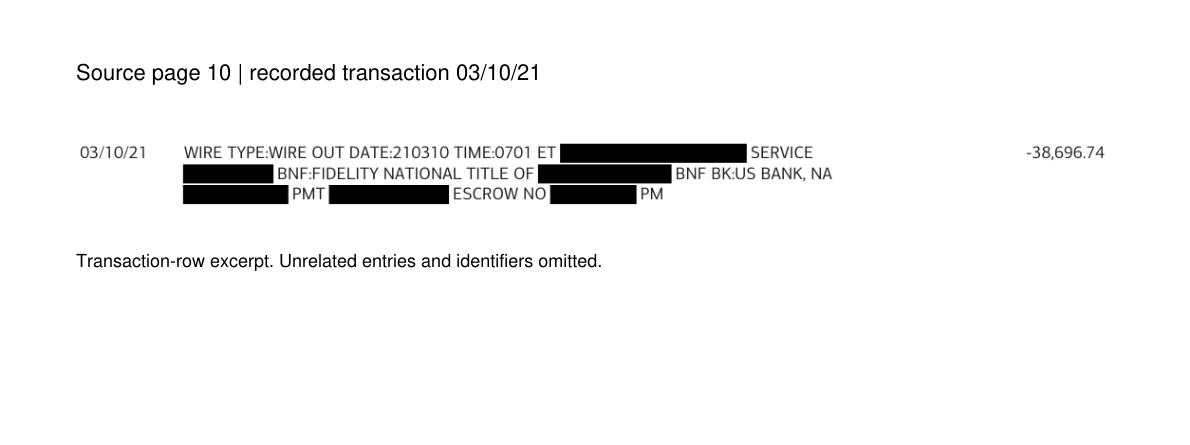
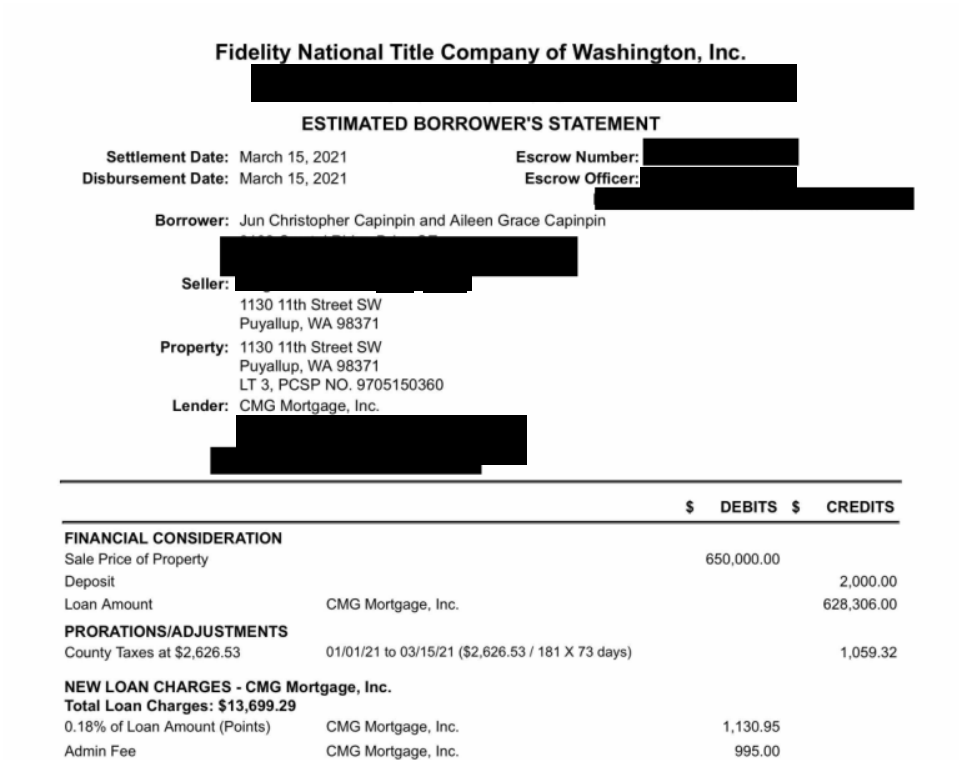
March 10–15: Romeo's personal account made the $38,696.74 wire matched to Silver Creek's escrow and cash-to-close statement. The separate $2,000 earnest check cleared January 20 and appears as an original deposit credit in the estimated March borrower’s statement; Fidelity's detailed trust-receipt ledger remains desirable. The $650,000 Silver Creek purchase used an approximately $628,306 FHA mortgage naming Jun and Aileen as borrowers; this is not the same as a cash purchase of the entire property price. A March 15 Goldwater letter independently named Romeo and Annie as prequalified for an $825,000 conventional loan—subject to underwriting, not a guarantee of any particular Silver Creek mortgage.
March 31–October 4: Goldwater issued another conditional $1.2 million conventional prequalification dated March 31. The July 12 Edgewood closing disclosure states a $950,000 purchase price and $855,000 conventional loan. A Houston warranty deed dated September 30 and recorded October 4, 2021 names Romeo and Annie as buyers; the companion purchase-contract material reports $163,000, but the deed itself is not a final closing-statement verification of that amount.
On July 18, 2025—not 2021, Jun's documented position said Romeo and Annie were ineligible to be named on Silver Creek's title because of FHA-related financing limitations. Those records establish identified cash resources, conditional conventional prequalifications, and a later documented purchase. They challenge a blanket assertion that Romeo and Annie could not buy property in 2021. They do not show whether Silver Creek's particular FHA financing would have been available with different borrowers in February or March 2021. Jun and Aileen's use of their credit, liability as borrowers, and claimed loss of other FHA benefits deserve accurate acknowledgment; those risks do not erase the source of the closing cash.
APRIL 30–MAY 1, 2021 / WORK AND CONTRIBUTIONS
They could choose whether to remain involved. What did they expect to contribute?
Romeo challenged the proposed partners to share operational responsibility. In the May 1 native-message sequence, Aileen acknowledged that she and Jun had no savings or investments, said she had expected not to have to spend money on startup, and described the effort Romeo and Annie were already putting in. She explained that pregnancy, family demands and discomfort with administration limited what she could take on. She offered patient-care and hands-on tasks once residents arrived. Those circumstances and that intended contribution matter.
The distinction that matters: the family discussed shared participation in a property intended for AFH use, but the cost and work were not simply interchangeable. On July 18, 2025, Aileen herself wrote that she and Jun had backed out of the business partnership while asserting that the house arrangement remained. Read both clauses: her admission of a former partnership should not be stretched into a concession that all property rights ended, and her property qualification cannot erase the earlier joint-venture discussions.
Aileen wrote, then i guess it means i'm out? or we are out?
and that if Romeo and Annie wanted them to leave, they would, adding this tym d nako maghilak2
—in context, this time I will not cry. This establishes a contemporaneous offer to let Romeo and Annie decide the business-partnership question; it is not an executed release of a separate claimed real-estate interest. In a July 2025 message Aileen distinguished backing out of the partnership from what she said remained agreed about the house. That disagreement must stay visible.
Romeo's same-day messages clarify his own funding approach: he would pay the other startup/improvement costs, ask Jun and Aileen for only their share of mortgage and utilities, and look to the future business to repay his advances. Romeo and Annie now characterize the mortgage-and-utility sharing while the couples lived together as household expenses rather than independent capital investment. The character and total amount of each couple's contribution remain disputed and require a reconciled ledger of payments, credits and any separate investment. We do not assert an independently verified ceiling on the Capinpins' contributions.
Romeo and Annie recall an earlier February 2021 discussion in which Aileen cried when told they could purchase the property independently. A contemporaneous February 28 reassurance says We are NOT KICKING YOU OUT.
Together with her May phrase about not crying this time, that supports their interpretation of the relationship tension, but does not independently establish the alleged crying or the precise February conversation. It would be wrong to treat later silence or an unchallenged recollection as a legal admission.
Contested contribution classification: the Capinpins' early mortgage-and-utility payments while the families occupied the house, later residence-related expenses, any actual reimbursement of acquisition funds, house painting, and equipment purchases have different accounting meanings. The contemporaneous Venmo export documents a $1,000 April 30, 2021 payment from Jun to Romeo marked “Silver Creek house paint.” It cannot be relabeled a down-payment reimbursement. The June 14 message discusses a “down payment” transaction but its cropped screenshot does not display the transfer amount. Romeo and Annie dispute how much of Jun and Aileen's overall spending is properly classified as equity investment; no resolved dollar total is asserted here.
02 / FOLLOW THE MONEY
The $38,696.74 wire is real. Its legal meaning remains disputed.
Bank and escrow records trace a March 10, 2021 payment of $38,696.74 from Romeo's personal account and connect that payment to the acquisition. The January 2021 $2,000 earnest check cleared the personal bank account, and the estimated March borrower’s statement accounts for it as a deposit credit. The separate $38,696.74 closing wire supplied the remaining cash to close. Fidelity's trust receipt remains useful as an additional confirmation.
That contribution should not be understated. Nor should the Capinpins' borrowing responsibility and the signed lender gift certifications disappear from the public explanation. Financing labels, repayment expectations between relatives and actual ownership rights can diverge; a published account must disclose that tension rather than assume the answer.
The preserved U8 archive contains fuller acquisition and financing material, including estimated statements and signed documents. A record-specific publication decision is required before reproducing those PDFs.
 Open source excerpt E03
 Open source excerpt E04
The sequence matters. A January 19, 2021 Bank of America check image shows $2,000 payable to Fidelity National Title from Romeo and Annie's account. On March 10, a separate Romeo-origin $38,696.74 outgoing wire matches Fidelity's escrow reference and the estimated March borrower’s statement’s stated cash to close. The $2,000 check cleared January 20 and is separately credited on the estimated March borrower’s statement; the distinct $38,696.74 wire represents additional cash to close. Thus $40,696.74 is traceable gross earnest-plus-closing cash, not a duplicated payment or the full purchase price. Fidelity's original trust ledger would further corroborate the escrow receipt chronology.
Repayment discussed after acquisition: a June 14, 2021 contemporaneous exchange explicitly discusses using a “down payment” label on a transfer and Jun responds to the correction. This reinforces that the parties distinguished their own retrospective equalization payments from the original escrow disbursement. The June 14 personal Bank of America statement now confirms a $1,000 incoming Zelle from Jun (T0BPMXXML), one day after the Messenger discussion. Separately, Aileen's April 18 native itemization marked $1,000 as AFH down payment inside a $2,139 completed Venmo from Jun; its original 'rent' label is retained. These are two specifically supported $1,000 post-closing reimbursement components, distinct from earnest-money escrow and from later conditional monthly payments.
The lender forms and the family arrangement must both be confronted.
The $650,000 purchase included an FHA loan naming Jun and Aileen as borrowers, alongside the identified acquisition money from our side. These were different contributions to the transaction. Our $2,000 earnest check and $38,696.74 closing wire are not the full price paid in cash.
U8 preserves two signed lender gift forms saying repayment was not expected. We do not dismiss those representations as “just paperwork.” The family discussions described participation tied to acquisition money and its anticipated repayment; the lender forms point another way on repayment. A credible ownership account has to confront that tension.
The newer bank and closing-document reconciliation confirms the separate earnest and remaining cash-to-close amounts. It also identifies two later $1,000 reimbursement components. That is a narrower, stronger record than treating every transfer as ownership capital or declaring the gift certifications irrelevant.
The documents support our contribution and show why we disputed an ordinary-tenancy account. They do not independently decide a legal ownership percentage, a trust remedy or the enforceability of the family understanding.
Source trail: U8 guide §2; RR17 signed gift forms; RR23 acquisition wire; RR30 earnest check; newer bank and closing-disclosure reconciliation. Trace the separate payments and their classifications.
Return to the connected investigation →03 / THE WORK BEHIND THE BUILDING
The house carried a care business and the cost of keeping it running.
Romeo and Annie operated the licensed adult family home through ABC Elder Care. The site was a workplace for caregivers and a home for residents, not merely a vacant investment address. That context explains why the threat of losing possession was consequential even without a completed eviction.
Work, renovations and recurring payments may benefit both an operating business and a property owner. The September 2024 messages about improvements contain a revealing disagreement over who benefited, followed by Aileen's statement that property benefit “it will” occur. That response is not an admission of any precise equity share or legal ownership.
No resident-specific medical or family records belong in this public narrative. Details of individual residents are irrelevant to documenting the title and possession dispute.
The care-home purpose explains the work. The purchase was discussed as the site of an adult family home, not an ordinary single-family rental unaffected by licensing. Conversion, safety work, equipment and ongoing upkeep therefore served the agreed operating purpose. Saying that renovations benefited the business does not logically establish that permanent improvements conferred no property-value benefit on the titled owners. The lease placed substantial responsibilities on ABC, and the extent, cost and reimbursement treatment of each improvement remain subject to receipts and the parties' actual agreement.
The mortgage-linked stream did not vanish after the 2025 dispute. ABC Elder Care's business bank statements show a March 6, 2026 payment to Jun of $3,798.68, a May 6 payment of $3,798.68, and a July 7 payment of $3,629.35—before the July 23 recorded transfer. These bank entries show ABC making substantial ongoing property-related remittances even as title remained in Jun and Aileen's names. They do not, standing alone, prove the lender posted every intervening installment; the complete month-by-month mortgage, escrow and bank reconciliation remains necessary. The Capinpins were still the named mortgage obligors until payoff or release, and that exposure was real.
The September 2021 repair messages make the operating responsibility concrete: we were coordinating a crawlspace response before resident move-ins, with Aileen cooperating on insurer contact. The bills that followed are available below, but neither invoice is proof of payment. The down-payment bill may overlap the larger invoice; insurance and final net expense remain unresolved.
Open the repair-coordination messages — 2 pages · Read the remediation bills — 3 pages
04 / READ BOTH THE LEASE AND THE AMENDMENT
A no-default recital. A later lawsuit claiming arrears dating to 2021.
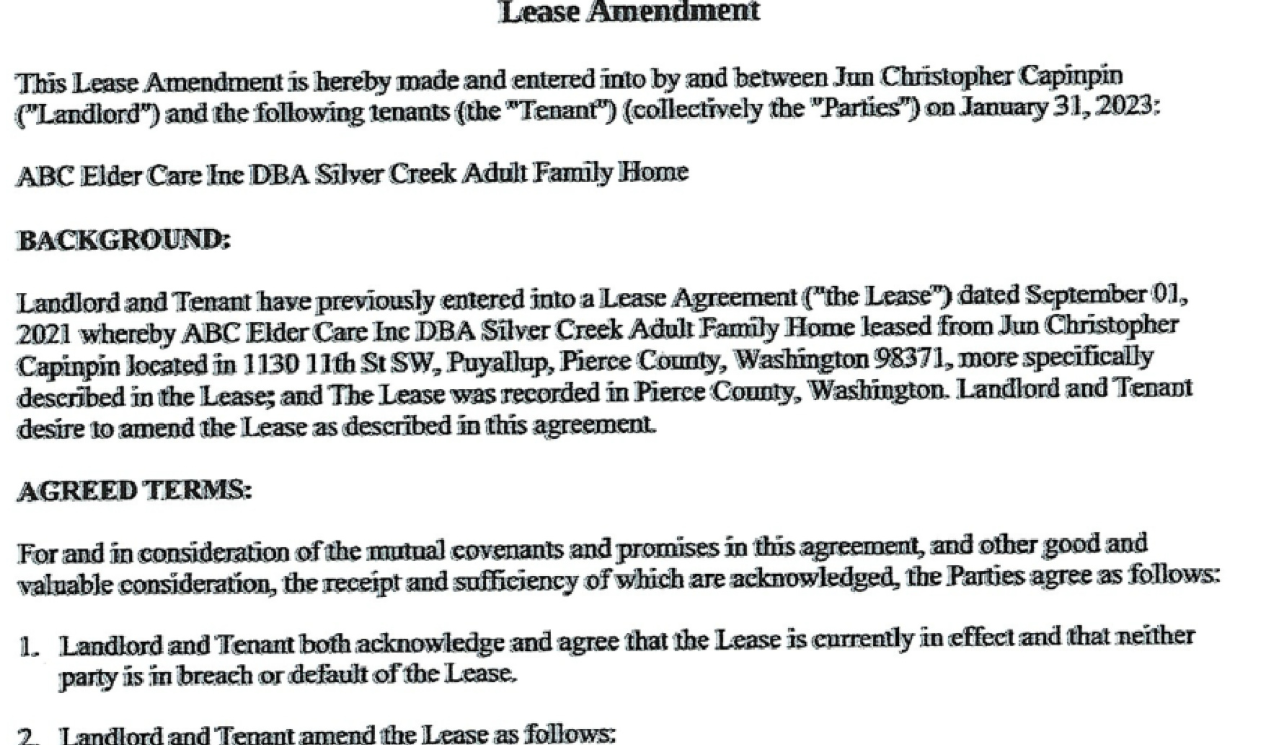
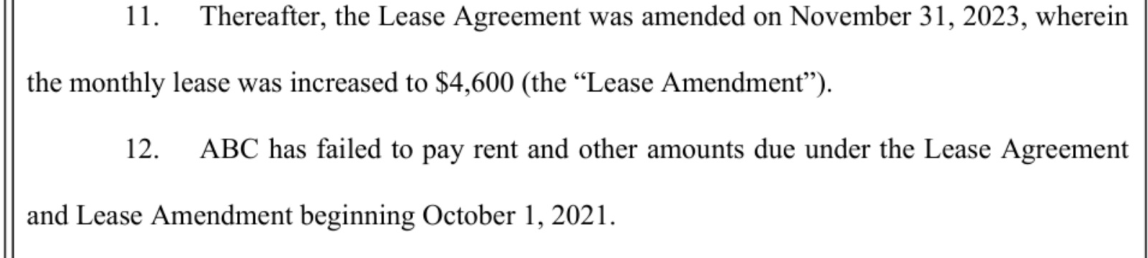
The parties entered written lease arrangements, and those terms matter. The amendment bears a January 31, 2023 date but was reportedly executed September 26, 2024; the crop alone does not authenticate both parties' signing dates. It contains a recital that neither party was then in default. In November 2025 the Capinpins' complaint alleged monetary obligations dating to October 2021. These records require a coherent explanation of what was owed, the period to which the recital referred, what was credited or waived, and what occurred afterward.
The no-default recital does not conclusively disprove a later default. Conversely, a pleaded arrears calculation is not a judicial finding. We ask for reconciliation, not automatic acceptance of either side's retrospective account.
A full document release needs source-specific review of signatures, incidental financial details and any month-by-month allocation. The U8 preserved register contains the deeper leases and diagnostic comparisons, but an incomplete payment spreadsheet must not be styled as a certified court accounting.
 Open source excerpt E08
 Open source excerpt E09
A documented pause is not the same thing as later withholding.
The January 2023 messages concern a particular accommodation affecting the additional $1,000 when census fell. Bank records show $3,600 transfers in February and March and $4,600 in April. That sequence corroborates implementation of a pause and resumption; it does not erase the fixed-rent language in the signed documents.
The later 2025 withholding belongs to a different phase of the dispute. Located July–October transfers of $3,798.68 match the mortgage amount shown due for July in the supplied servicer record. A payment to Jun is a recorded transfer, not proof that the lender received and correctly posted every installment.
The accounting needs dates, categories and credits. Mortgage-sized remittances, an agreed startup accommodation, a disputed contractual component and a court-adjudicated arrears figure are not interchangeable. No final adjudication of the entire arrears theory is presented here.
The later demand’s arithmetic can be followed in part: $27,205.28 claimed November 10, less the November 12 $3,798.68 payment, equals the complaint’s $23,406.60. That explains the reduction. It does not supply a complete month-by-month derivation of the original October demand.
We challenge the demand’s reconciliation with the accepted payment history and no-default recital. We do not claim the entire demand was invented.
Source trail: U8 guide §3; I1-N payment sequence; I6-R/I6-L financial and lease diagnostic collections; November bank statement, notices and RR01 ¶20. Compare the recital and pleaded default period · Read the money trail.
Return to the connected investigation →05 / WHEN THE WORDS CHANGED
The record uses more than one way to describe whose house this was.
Across the January 2021 shared-house language, June 2025 references to “your house,” the July 18, 2025 informal “Reinstate 50/50 Ownership” / “Revert to the original ownership structure” proposal, and Aileen's July 19 challenge “inyuha diay ang Silver Creek? delusional,” the record shows sharply different descriptions of the property. Her July 19 message also urged obtaining lender approval; a July 20 email quotation within Romeo's reply describes “ANOTHER business loan” to buy “OUR house, Silver Creek.” These are separate messages with different evidentiary strength, not a single negotiated agreement. See the actual privacy-cropped informal proposal and E06 / E07.
The phrase “OUR house, Silver Creek” is not a separately authenticated original email sent by Aileen in the presently selected source set. It appears as text quoted inside Romeo's reply and is attributed that way. The June 26 excerpt also ends mid-sentence. Those are non-negotiable qualifications, not reasons to erase the excerpts. The July 18 message was an informal option raised before later counsel-led discussions and the January 2026 mediation; neither its “revert” terminology nor its sale alternative constituted the settlement that was eventually signed. The displayed proposal includes Options 1 and 3 but not the whole numbered sequence.
A sharp publication can allow a reader to identify inconsistency without pretending that selected messages prove motive, forged records or intentional deception. The original U8 source sequences remain preserved for eventual context-complete review.
FUTURE EQUITY IS A KIND OF ANTICIPATED BENEFIT
In a September 30, 2024 exchange—not a newly discovered 2025 admission—Aileen retrospectively said they had not agreed to an earlier purchase because they expected the property's equity to rise and viewed that value in retirement terms. She also asserted that their financing help counted and that Romeo and Annie's spending should be deducted before any remainder was divided. This challenges an unqualified account of no benefit from Silver Creek, but does not prove a fixed February 2021 refusal, a secret scheme, or any legally adjudicated equity share. Jun and Aileen's actual mortgage-risk and financing-cost arguments remain part of the record. Source: corrected iMazing-derived September 30, 2024 passage (R1 E05, physical page 16; native discussion as catalogued in U8).
A specific competing equity formula appears in their own words. In a September 30, 2024 exchange, Jun wrote that if the property was sold or equity withdrawn, Romeo and Annie's expenses would be deducted first and the remainder split. A July 18, 2025 message attributed to Aileen similarly described equity after deduction of renovation expenses “with interest,” then division by two. That history must be confronted alongside statements that renovations benefited only ABC. The messages are evidence of bargaining positions and stated expectations, not an agreed judicial accounting or final entitlement to 50% of net equity.
What they said they put at risk: on June 26, 2025, Aileen argued that the Capinpins' FHA qualification enabled a 2.75% Silver Creek loan while their later home financing cost 6.75%, invoking credit exposure and foregone opportunities in her view of “what's truly equitable.” That is a documented claim about finance, not an independent appraisal of lost opportunity. A derivative quote bank attributes to Jun on June 26 a claim that they had spent about $12,000 on the house, but the exact originating message and composition of that amount still require source and ledger verification. The separate dispute over whether initial co-occupancy mortgage payments are recoverable capital investments is unresolved.
Do not misquote the lawyer assertion: Aileen's July 18, 2025 report that her lawyer was strongly opposed concerned the proposed quitclaim/title change while their mortgage risk might remain. It must not be presented as an independent lawyer's adjudication of the overall equity calculation.
06 / THE TITLE-TRANSFER PATH
A signed path to purchase existed. Closing did not occur on the first schedule.
The record includes proposals to change title, lender discussions and a 2025 purchase agreement with extensions. We pursued title transfer, but the 2025 financing and closing route did not complete on its original schedule. That inconvenient fact must remain part of the story.
Different explanations were advanced for the failure to conclude earlier. To attribute every delay to one party would go beyond the documented record. The more defensible question is what each dated proposal required, what each party agreed to, and which conditions actually occurred.
The full U8 contract and lender-source collection is preserved. The website will not reproduce signatures, private underwriting fields, entire applications or privileged negotiation material absent specific publication decisions.
Open the purchase agreement and conditional lender letter — 20 pages · Read the August 4 extension — 2 pages · Read the August 31 extension — 2 pages
The selected contract reader retains the material financing terms and complete lender qualifications. Omitted tax/title pages and the broader private collection remain unpublished.
RECONCILE THE ROUTES, DON'T COLLAPSE THEM
The documentary trail includes a proposed add-to-title/refinance/quitclaim path, a 2025 purchase agreement and extension attempts, then the January 2026 settlement and July 23 recorded deed. A discussed quitclaim was not an executed transfer; a signed purchase agreement was not a completed closing; and a refinance proposal did not itself release the Capinpins from debt. The exact agreed deadlines and failed lender conditions belong to the retained dated source records, not a simplified accusation of deliberate obstruction.
The proposed deed routes had conditions. The failed closing is part of our story.
Open N26: Aileen’s June 30, 2025 conditional proposal. This is the exact approved one-page source selection; an asserted position and conditional proposal, not an executed transfer.
The discussions moved through adding our names to title, refinancing, and a conventional purchase. Adding a name to a deed would not itself release an existing mortgage borrower. Jun and Aileen’s concerns about remaining loan liability were real context for those proposals.
We also requested a financing pause. The signed purchase agreement and extensions—including the later August 31 deadline—belong beside refusals and conditions. The June 30 no-net-profit and transaction-cost proposal remained conditional; it was not a completed conveyance or acceptance of every amount we claimed.
JUNE–JULY 2025 · THE WRITTEN TERMS
The purchase structure was written down. Financing still had conditions.
Form 21 specified a $610,000 purchase price, $1,000 earnest money and July 23, 2025 or sooner for closing. The form bears a June 25 date; buyer signature fields show July 1 and seller fields July 2. Those dates should not be collapsed into a single signing date.
The July 2 addendum contemplated paying off the mortgage and covering settlement costs, with no net proceeds expected for the sellers except attorney-fee reimbursement capped at $3,000. Unused loan proceeds remained subject to lender and escrow requirements. That is a concrete proposed purchase structure—not proof of how funds were ultimately distributed or of either side’s total investment.
The June 24 lender letter required a clean preliminary title report. It also reserved changes and revocation and stated that it was not an obligation to lend. The agreement retained its financing contingency. The August 4 and August 31 extensions show that additional time was agreed; they do not establish guaranteed financing or explain every delay.
The July 20 date in Jun’s earlier message and July 23 in Form 21 remain distinct. No reconciliation or fabrication finding is supplied by these documents.
Open the purchase agreement and conditional lender letter — 20 pages · Read the August 4 extension — 2 pages · Read the August 31 extension — 2 pages
We did not complete the purchase on the 2025 schedule. That failure does not erase the preceding family arrangement, funding or work. It does mean we cannot describe financing as ready whenever we requested title or attribute every delay to the Capinpins.
The July communications also addressed how the dispute might affect the AFH business. Those statements provide context for our experience of pressure. They do not establish that an anonymous regulatory complaint was promised, authored by a particular party or part of a proven coordinated plan.
Source trail: U8 guide §§4–5; RR18 lender sequence and our pause; RR20 quitclaim condition; I5-S signed agreement; I4-D extensions; I3-E quoted July email and reply. Compare the alternatives with the later possession request.
Return to the connected investigation →NOVEMBER 27–DECEMBER 2, 2024
The proposed title change reached lender and title professionals.
The preserved Renown Mortgage email introduces Chicago Title to prepare a quitclaim deed adding Romeo and Annie to title. A December 2 title-company reply asks about scheduling, and Romeo confirms a Wednesday call. Those are identifiable steps toward a title change, not just a family conversation about one.
The route did not itself transfer ownership, guarantee financing, or release Jun and Aileen from mortgage liability. The later attachment pictured in the compilation references Edgewood and is not treated here as an authenticated Silver Creek deed.
Open the selected, redacted email transcription →Selected transcription from the preserved compilation, pages 1, 3–4; not a native sender-original export.
07 / THE PROTECTION-ORDER RECORD
A serious accusation is not a court finding.
The emergency filings and reported incidents deserve care, not caricature. On November 4, 2025 the requested protection orders were denied on the merits after a hearing and dismissed. The written court material also contains a contact caution that our side must acknowledge.
A denial order is not a judicial finding that every allegation was fabricated, nor does it establish malicious intent by the petitioners. Reporting statements and police observations must be attributed to their actual speakers.
The preserved U8 materials contain larger reporting comparisons. They also include unrelated personal and third-party details and are not released wholesale. No confidential source excluded by the privacy process is reproduced or paraphrased here.
The December police assessment is part of the record too.
U8’s guide describes Officer Miniken documenting our December complaint and explaining why false-reporting charges were very unlikely on the information discussed and reviewed. His narrative recorded acknowledgment of underlying messages and encounters and distinguished court case numbers from police-report counts. Those observations remain material context for our criticism.
The guide also records his question about whether the alleged third-party communication violated the order and a referral for prosecutor review. That observation is not a final prosecutor disposition or judicial decision.
Our December submission already included the default-retaliation connection and TPO materials. Later July court records, digital-evidence audit output and recordings expanded the collection available to us, but we do not recast every theme as something first discovered afterward.
A later release to us does not establish that an officer lacked earlier access or ignored evidence. Unverified playback cannot establish spoken words, surprise or tactics. We challenge particular context, attribution and interpretations; the record does not support a blanket claim that all events were invented or that police established knowing falsity.
Source trail: U8 guide §8; preserved December 4 assessment and sent-email attachment reconciliation. No confidential completed service-form content is reproduced or paraphrased. Read the reporting distinctions and written merits outcome.
Return to the connected investigation →08 / WHAT THE EVICTION COMPLAINT REQUESTED
They did ask for possession. The court did not carry out an eviction.
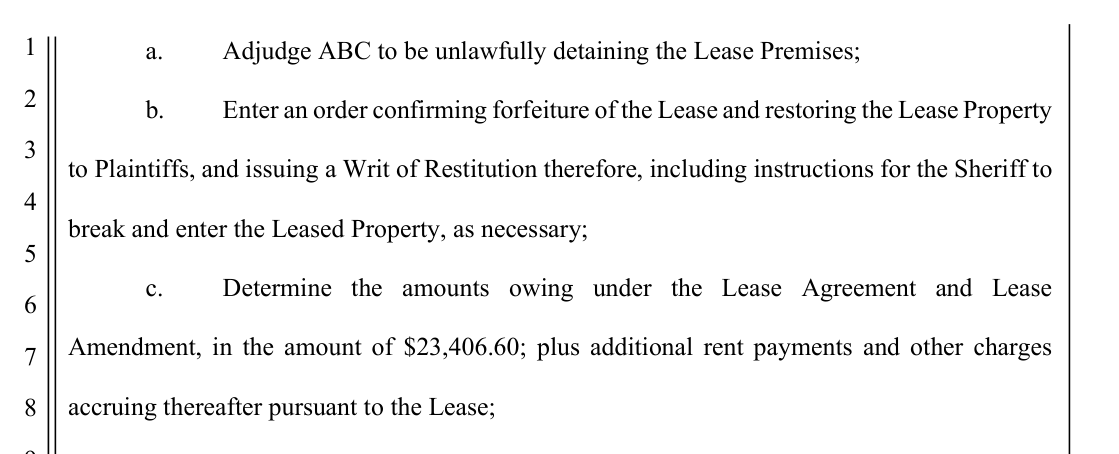
The November 24, 2025 complaint sought lease forfeiture, restoration of possession and a writ of restitution. That is what the pleading requested. The request was consequential because ABC Elder Care operated an adult family home in the building.
The case did not end with a writ-enforced displacement of the home's residents. Distinguish the remedy requested from any remedy actually granted. Calling the complaint a completed eviction would misstate the outcome.
The ownership complaint was prepared December 26 and filed December 29, 2025, in case 25-2-14126-3, as the supplied e-file receipt and court docket confirm. The separate ownership lawsuit, protection-order filings and later settlement are distinct proceedings. Their pleadings should not be used as substitutes for proven facts or a judicial merits judgment.
 Open source excerpt E13
09 / THE ENDPOINT
Settlement. Dismissals. A recorded deed. Not a fraud verdict.
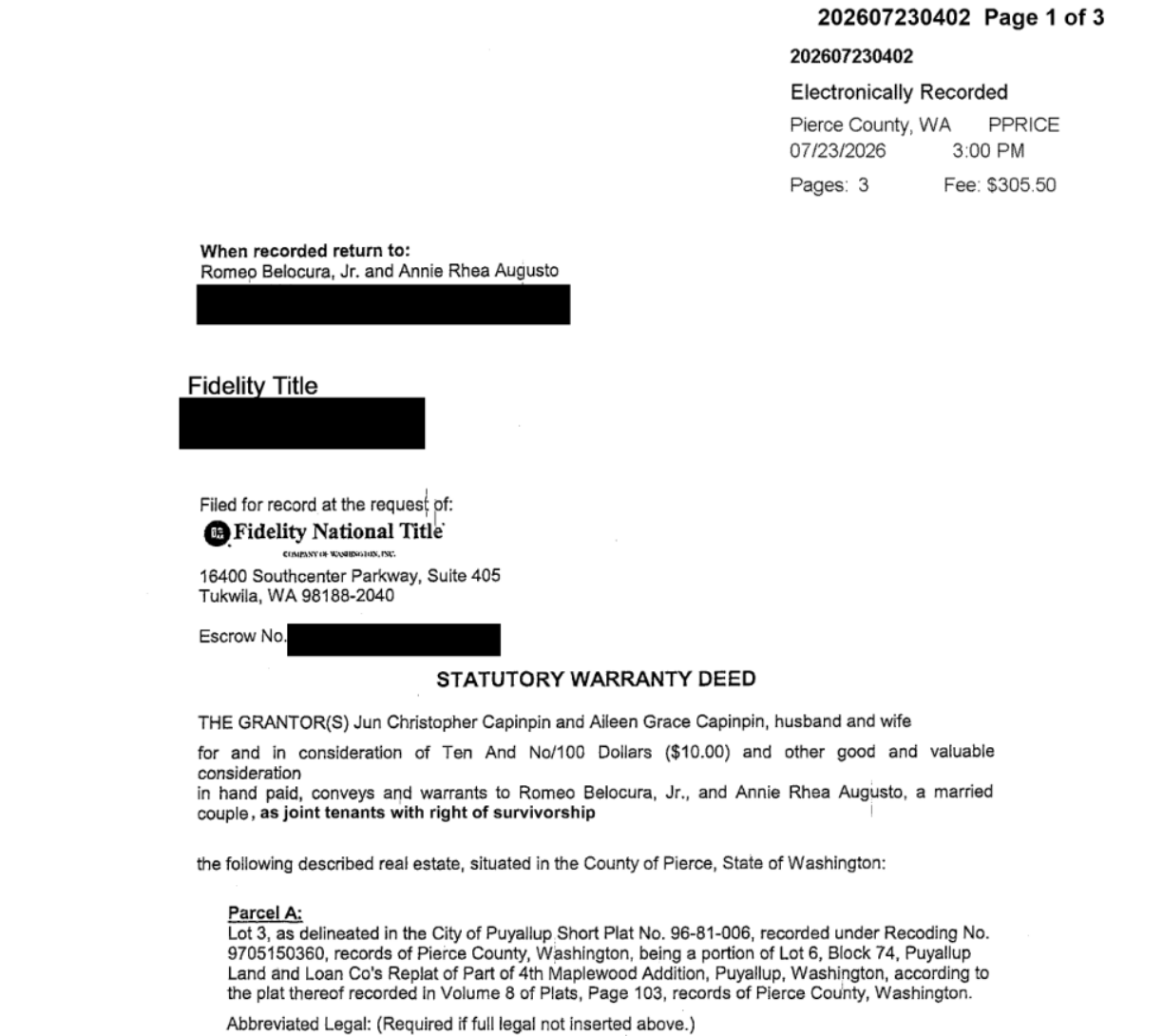
The parties reached a signed settlement in January 2026. Litigation was dismissed; the negotiated warranty deed was recorded July 23, 2026 and conveyed the property to Romeo and Annie. This is the documented ownership endpoint.
The settlement includes broad mutual releases, later-discovered-facts language, a no-admission provision and an attorney-fee term for disputes over the agreement. Public discussion is not exempt from those contractual risks merely because it includes true documents.
We can say the eventual deed was recorded and that the eviction did not occur. We cannot say a court adjudicated fraud, found the Capinpins malicious, or awarded quiet title on the merits. The deed came through the negotiated resolution.
 Open source excerpt E14
10 / THE CONTRARY EVIDENCE
We do not strengthen a public account by hiding what complicates it.
The Capinpins held recorded title and were exposed to the mortgage loan. Signed lease and lender documents exist. Signed gift certifications have to be addressed, as do the purchase route that did not close when first contemplated, later payment disputes and the judicial contact warning.
That material does not erase our acquisition payment, the pre-closing language, the no-default recital, the improvements debate or the possession request. It does keep the account from becoming a one-sided substitute for the record.
The central claim is not that a hidden intention has already been proven. It is that the fuller record deserves examination alongside the simple lease narrative. Readers should distinguish what is documented, what we infer, what the Capinpins disputed, and what remains unresolved.
The central accounting remains open rather than hidden. The April 2021 $1,000 house-paint receipt is verified in Venmo; the June 2021 “down payment” exchange is now corroborated by the June 14 $1,000 incoming Jun bank entry; the separate $2,000 earnest check cleared January 20 and is credited on the estimated borrower’s statement, while the detailed escrow trust receipt remains an additional confirmation; a June 2025 $12,000 self-report has no yet-reconciled component ledger. A published calculation that treats early household mortgage shares, equipment for ABC, capital improvements, the original FHA liability and cash to close as interchangeable dollars would be misleading. We will report each category separately, and allow contrary invoices or loan evidence to be tested.
GO DEEPER WITHOUT LOSING THE DISTINCTION
The documents and their limits, in one place.
U8 preserved the comprehensive documentary workspace: 65 PDFs, 799 included historical PDF pages, 89 standalone images and multiple reader editions. Those sources remain in the private evidence archive. The public evidence index lists individually reviewed downloads, not all of these private archive items.
Where an original source is later approved, the catalogue will point to the exact reviewed, redacted edition—not a similarly named crop or an unchecked historical copy.
June 2026 payments: ABC Elder Care’s business account records the $3,798.68 payment to Jun on June 9; Freedom Mortgage records a matching installment on June 12. See the dated payment sequence.