On November 24, 2025, Jun Capinpin and Aileen Capinpin filed an eviction complaint concerning the Puyallup property where Silver Creek operated an adult family home.
The complaint sought money, forfeiture of the lease, and possession. It named ABC Elder Care, Inc. and “Unknown Occupants” and requested a writ authorizing the sheriff to “break and enter the Leased Property, as necessary.” [1]
Those were requests, not awards or an eviction already carried out. Annie and I continued operating Silver Creek, and no resident was displaced through the eventual resolution.
But the request for possession was real. And the property was a home where people received continuous care.
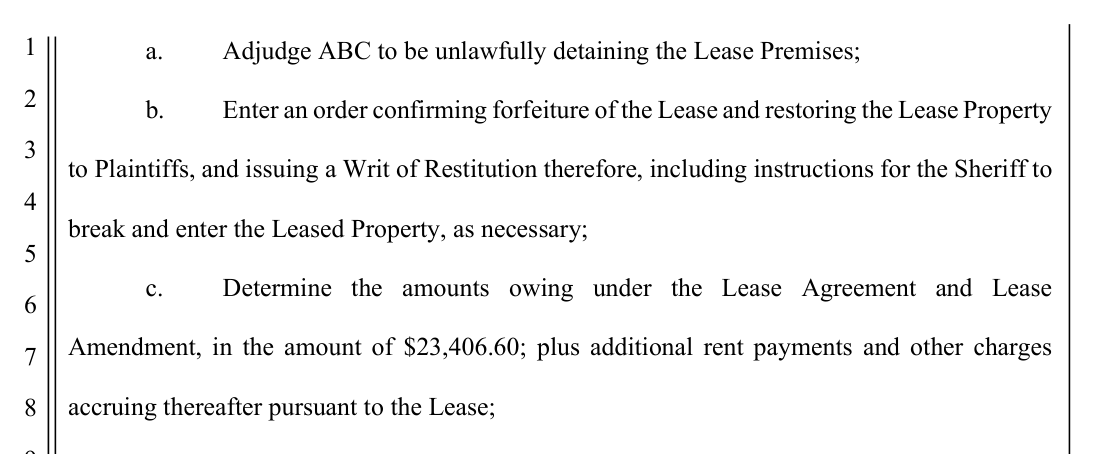 Enlarge excerpt ↗
SOURCE TRANSCRIPTION · COMMERCIAL LEASE, P. 1
“Tenant may use the Premises only for Adult Family Home Business”
Three comparisons to keep in view
- The place: the complaint sought possession; the lease specified an adult family home.
- The account: the extra $1,000 stopped; other payments continued; two amendment documents contained no-default language.
- The consequence: the proposed exit concerned title, debt and sale. The complaint and response did not explain continuity of care if possession changed.
The outcome: the cases were settled and dismissed. Annie and I completed the purchase on July 23, 2026. We kept the home operating, and no resident was displaced.
Before the lawsuit, there was a family arrangement
I agreed to continue with the property in Jun and Aileen’s names because I believed in our family venture. We left essential terms unfinished; I later offered additional money to keep the property available. Read the full origin story →
Annie and I understood that our families would build a business together.
Title and the mortgage remained in Jun and Aileen’s names. Their financial liability was real. Annie and I committed money, work and resources to the care-home venture while relying on cooperation to resolve ownership.
By 2025, the families described that history very differently.
At the October 21, 2025 ex parte protection-order hearing, Jun emphasized legal ownership, described Annie and me as tenants, and alleged pressure, coercion, harassment and intimidation over the property. Aileen described the business plan and why she and Jun withdrew, including her account of my anger during money discussions. Those were their allegations and perceptions, not findings resolving the property dispute. [2]
My own communications included insults, demands and language I acknowledge was forceful and, at times, hostile. Those words remain part of this account.
They do not replace an examination of the agreements, the payments or the amount claimed.
Signed leases existed. They matter. The question is how those documents fit with the rest of the record.
Read one qualified hearing quotation
JUN · OCTOBER 21, 2025 EX PARTE HEARING
“Um, now they are trying to acquire that property through, um, uh, pressuring us or coercing us to sign a quit claim.”
Working transcription, not court-certified. Jun and Aileen held recorded title and mortgage obligations. Signed leases, the family venture, earlier conditional-signing messages and my forceful demands remain material context. The later denial of full protection orders did not establish dishonesty.
Why the additional $1,000 matters
The additional $1,000 was linked to the census in our account. I also called it rent. Read the full payment comparison.
Payment excerpts and reconstruction
In December 2022, Aileen asked about beginning the additional payment after the home reached three residents, referring to the parties’ prior arrangement. I answered that it would begin in January, continue for 60 months and be added to the rent. My use of the word “rent” matters too. [3]
Our accounting export records $4,600 in January 2023, $3,600 in February and March, and $4,600 again in April. Annie and I attribute the temporary reduction to the census falling below the three-resident threshold. [4]
The reconstruction identifies 24 additional $1,000 components through February 2025: January 2023, followed by April 2023 through February 2025. That totals $24,000 within the larger payment stream. It is not an additional pool to count again, an established ownership percentage, or a final accounting.
Follow the census condition and the 24 additional payment components.
RECONSTRUCTION · SELECTED MONTHLY PAYMENTS
The extra component paused. The larger payment continued.
| Month | Recorded payment | Identified extra component |
|---|---|---|
| Jan. 2023 | $4,600 | $1,000 |
| Feb.–Mar. 2023 each month | $3,600 | $0 |
| Apr. 2023 | $4,600 | $1,000 |
Read my own rent wording
Aileen’s preceding message invoked three residents and the prior arrangement. I answered on December 19, 2022:
“We can start the $1000 in January x 60 months. It will be added to the rent. So $4600 na. I will make an addendum”
Original mixed-language wording. My rent label stays beside the census condition. This message does not prove that an addendum was executed or decide every payment’s legal character.
The $1,000 stopped. Other payments continued.
In March 2025, I deliberately stopped the additional $1,000 because of the title-transfer dispute. This was a different explanation from the earlier census-related pause. It does not establish that withholding the amount was legally justified.
The accounting export records $3,600 monthly transfers from March through June 2025, followed by $3,798.68 from July through October as the mortgage-related amount changed. The export is our bookkeeping evidence, including our descriptions and annotations; it is not, by itself, independent verification from the recipients’ bank. [4]
The written agreements must also be read: the commercial lease states $4,500 monthly, and the amendments state $4,600. Payments below the written amount do not, by themselves, establish full compliance. [5]
The complaint alleged unpaid rent and other amounts beginning in October 2021. It claimed $23,406.60 through November 24, 2025, with additional amounts and relief requested. It did not allege that every transfer had stopped. [1]
The continuing payments belong in the calculation. So do the written amounts, amendments, credits and adjustments.
The October 20 demand was $22,605.28. The later cure notice demanded $27,205.28. The complaint sought $23,406.60. These are different stages of the demand, not interchangeable figures. [16]
An exact arithmetic reconstruction is possible. It does not establish that the charges were legally owed or that this was the calculation Jun and Aileen actually used.
The question is direct: What was paid, what remained due, and how was the demand calculated?
How the three demand figures reconcile—and what the $1,000 difference means
Editorial reconstruction, not the claimants’ ledger. The existing 49-month payment comparison records $200,194.72 in outgoing payments allocated to October 2021–October 2025. Assuming $4,500 monthly through November 2023 and $4,600 from December 2023 produces $222,800 in charges and the October demand’s exact $22,605.28 difference. The rate-switch date is a hypothesis, not a finding about execution or legal effect.
| Period | Model difference |
|---|---|
| October 2021–July 2022 | $10,000 |
| August–December 2022 | $4,500 |
| January 2023 | −$100 |
| February–March 2023 | $1,800 |
| April–November 2023 | −$800 |
| December 2023–February 2025 | $0 |
| March–June 2025 | $4,000 |
| July–October 2025 | $3,205.28 |
| Total | $22,605.28 |
The negative entries preserve nine $100 differences in our favor under this model. They are not proof of credits actually applied by the claimants.
$22,605.28 + $4,600 = $27,205.28.
$27,205.28 − $3,798.68 = $23,406.60.
That bridge is consistent with adding a November charge and crediting the November outgoing payment. It does not prove their actual allocation. November is outside the 49-month subtotal. Outgoing payment, bank posting, delivery and mortgage application are separate events; actual delivery/return and recipient-credit details remain unresolved for the specified Bill Pay transactions.
If the assumed $4,600 rate instead begins in February 2023, the model is $1,000 higher: ten months, February–November 2023, at an additional $100. No missing $1,000 cash payment is required to explain that difference. Other assumptions can also fit the demand; the claimants’ original charge-and-credit schedule has not been located.
A flat count of $1,000 for every paused or disputed month does not reproduce the complaint. The actual transfers changed, the written rates differed, and credits matter. The complaint alleges aggregate rent and other amounts, not expressly only the additional $1,000.
Compare the 2025 transfers with the written $4,600 amount
| Period | Recorded monthly transfer | Difference from $4,600 |
|---|---|---|
| March–June 2025 | $3,600 | $1,000 |
| July–October 2025 | $3,798.68 | $801.32 |
These are arithmetic comparisons with the stated amendment amount, not a determination that each difference was legally owed. Allocation, dates, other terms and credits remain relevant.
The no-default acknowledgments
The payment provisions matter. So do the acknowledgments beside them.
The recovered amendment dated December 19, 2022 states that neither party was in breach or default and sets the monthly payment at $4,600. [5]
How the January face date fits the September preparation record
The replacement document has a more complicated history. In September 2024, Jun requested a lease copy for a lender. Annie proposed updating and backdating the paperwork. I asked when $4,600 had begun, and Jun answered February 2023. I then prepared and sent a replacement amendment for signature. [6]
That replacement bears a January 31, 2023 face date, while the preparation and transmission record places it in September 2024. The sent copy had Jun’s signature line blank. A later recovered copy bears apparent signatures and January 2023 dates. Jun’s actual signing date remains unresolved.
A face date is not independent proof of when everyone signed. Nor does a file-creation date establish when a signature was added. Our participation in preparing the replacement must remain visible.
The replacement also states that neither party was in default.
Neither clause establishes that no later balance could arise. The lease’s written-amendment and nonwaiver provisions, and the amendments’ own terms, must be read together.
But the accounting question remains: How does a later demand reaching back to October 2021 account for those acknowledgments and the payments that followed?
SOURCE TRANSCRIPTION · REPLACEMENT AMENDMENT, CLAUSES 1–2
“neither party is in breach or default of the Lease.”
The next clause states monthly installments of $4,600, payable in advance on the first, no later than the tenth.
February: signing after preapproval
The signing discussion included a preapproval condition and hostile language from me. Compare the screenshot with the surrounding exchange.
February exhibits and surrounding messages
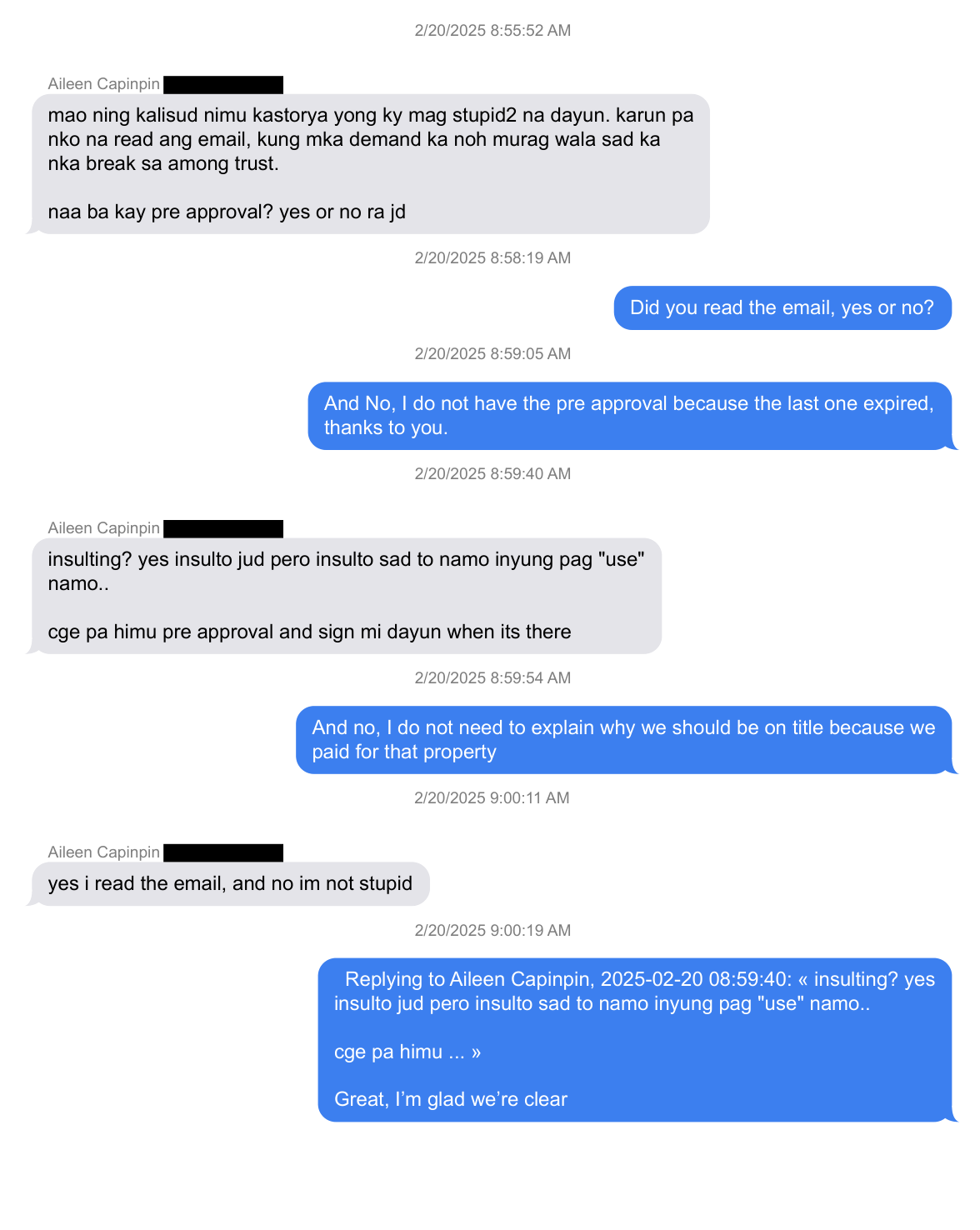
On February 20, 2025, Aileen asked for preapproval before signing a quitclaim deed. During that exchange, I wrote:
“Once I have it, you better sign. Keep everything in writing” [7]
The surrounding conversation includes my insults, requests for more time, and my acknowledgment that my earlier preapproval had expired. The demand was forceful. The surrounding messages also identify what “it” referred to: preapproval.
Later that morning, Annie said we would obtain preapproval and asked for the quitclaim to be signed afterward. Jun replied, “yes nie.” [7]
On February 21, in a separate direct message to Annie, Aileen again connected signing to preapproval. In a working English translation of her mixed-language message:
“Preapproval is all we’re asking for; we’ll sign immediately. What’s the problem with that? We’re just making sure you can get a loan after the title changes—that’s all.” [8]
These were conditional statements. They did not convey title, fund a loan or release Jun and Aileen from the mortgage. Financing still required further qualification steps.
The condition does not erase my tone. My tone does not erase the condition.
The route mattered as much as the stated goal. My account is that we proposed adding Annie and me to title while Jun and Aileen remained owners, then refinancing to pay off their mortgage before their final title release. By July, their proposal expressly rejected quitclaim. Purchase required us to assemble cash for the lender’s down payment. That helps explain why we sought more time; it does not establish guaranteed financing or an obligation to extend indefinitely. Read the financing sequence and its limits →
Read the request immediately before “yes nie”
SOURCE TRANSCRIPTION · FEBRUARY 20, 2025
Annie, displayed 9:23:32 a.m.
“We will get the pre-approval that you want. Please sign the quit claim after para mka move on na ta. We can’t keep delaying this.”
Jun, displayed 9:23:37 a.m.
“yes nie”
Original mixed-language wording. The request asks for signing after preapproval so they can move forward. The assent follows five seconds later; it does not establish deed execution or a binding conveyance agreement. Surrounding accusations and mortgage concerns remain material. Inspect the redacted source passage →
July: “our mutual goal”—with disputed terms
Jun and Aileen put their goal of leaving title and the mortgage in writing, raised their own financing concerns and called August 4 final at the time. A later extension ran to August 31. Read the deadline exchange and both extensions.
July exhibits, alternatives and stated deadline
By July, the parties were still discussing how to resolve the property.
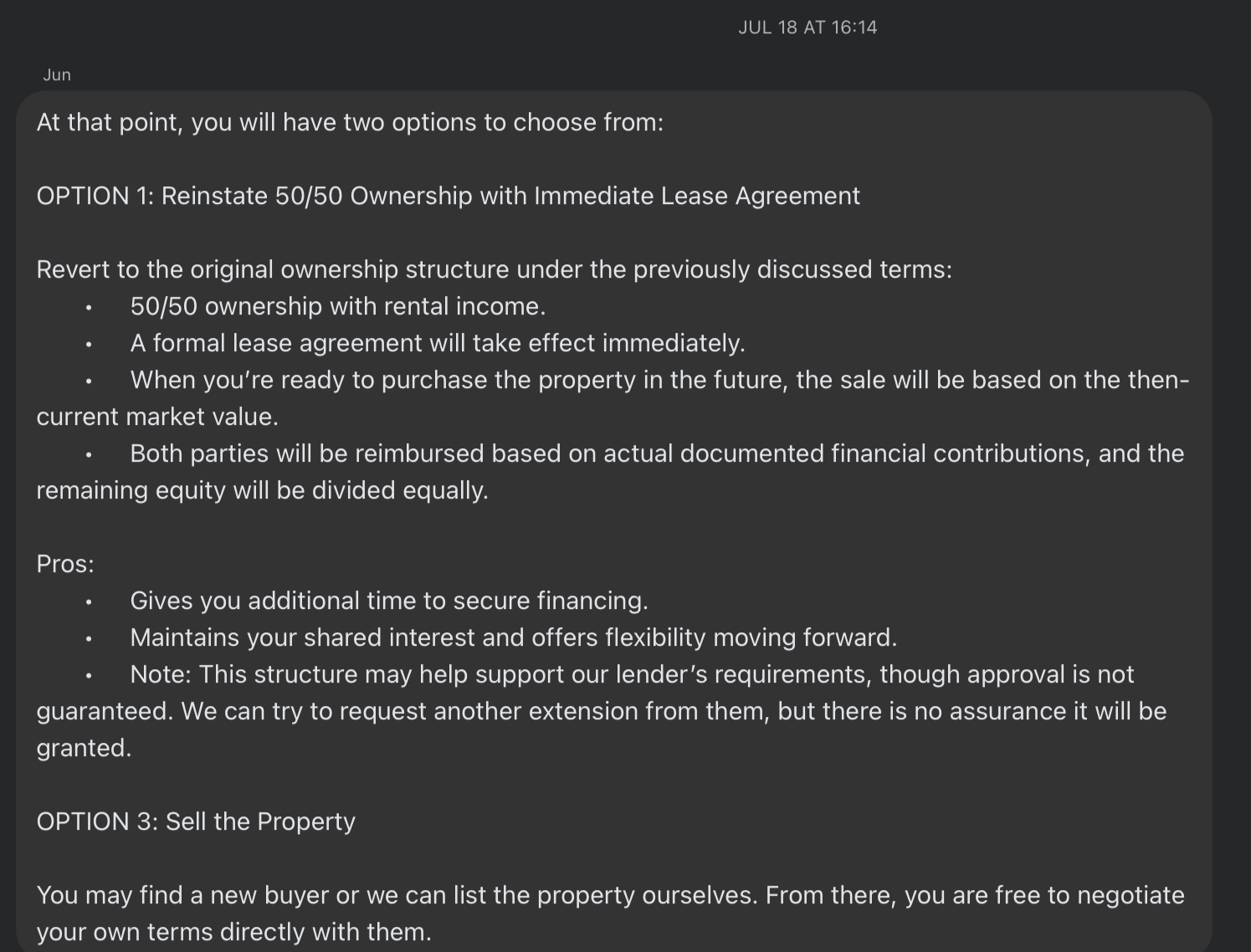
On July 18, 2025, Jun posted a proposal signed “Aileen & Jun” that stated:
“our mutual goal is to remove our names from the title AND mortgage.” [9]
Compare the July alternatives with the earlier compensation proposals.
Its opening expressly rejected the quitclaim route, accused Annie and me of bullying and harassment, and said Jun and Aileen would not extend beyond August 4. It described our lender backing out and linked the deadline to Jun and Aileen’s separate home purchase. These were the senders’ account and stated conditions, not independently established lender requirements.
The proposal offered three routes. “Reinstate 50/50 Ownership with Immediate Lease Agreement” contemplated rental income, an immediate formal lease, a future purchase at then-current market value, reimbursement of documented contributions and equal division of remaining equity. Another option would proceed under the purchase agreement with the stated extension; the third involved sale. [9]
The same message disputed our account of contributions and described the payments as rent rather than equity.
Those were negotiating positions. The “50/50” heading did not establish that Annie and I already held a 50 percent legal interest. And a shared objective of ending Jun and Aileen’s title and mortgage involvement did not mean the families agreed on the price, contributions, timing or method.
February’s conditional willingness to sign a quitclaim and July’s express refusal of that route both belong in the chronology. The stated exit objective remained; the route and terms were disputed.
The separate home purchase added pressure. Jun described a favorable rate, earnest money at risk and a “dream home” opportunity. Annie and I challenged why that transaction should determine Silver Creek’s timetable. I demanded purchase and loan information, imposed a deadline and threatened legal action; Jun characterized the conduct as intimidation and harassment. Purchase communications were later directed through counsel.
The 2025 purchase did not close on schedule. That failure remains part of the record. So do the conditional transfer statements and the stated mutual goal.
Inspect the July 18 proposal screenshot
 Enlarge excerpt ↗
PUT THE ACCOUNTS TOGETHER
The October account needs the missing context
At the October 21, 2025 ex parte hearing, Jun described Annie and me as tenants and said:
“Um, now they are trying to acquire that property through, um, uh, pressuring us or coercing us to sign a quit claim.”
Working transcription, not court-certified. This was Jun’s allegation. The written petitions also alleged coercion to sign and harassment after refusal. Inspect the petitions and selected messages →
The condition was part of their own conversation
In February, Aileen said they would sign when preapproval was there; Jun answered “yes nie” after Annie expressly asked for signing after preapproval. In July, their proposal called removing their names from title and mortgage “our mutual goal”—while rejecting the quitclaim route and disputing the terms. These were different stages of a contested transfer, not a completed agreement. [7][9]
The October allegation should be read beside their own conditional assent. The record contains more than owners refusing a demand to surrender their property: it contains discussions about a transfer, the condition for signing, and later disagreements over the route.
The selected screenshot shows the demand. It leaves out the condition.
The declaration filed October 21 includes my “Once I have it, you better sign” reply. It also retains Aileen’s preceding reference to what she had asked for. But the selected image does not show her earlier preapproval-and-signing sentence or Jun’s later affirmative response.
 Enlarge excerpt ↗
 Enlarge excerpt ↗
“It” had an identified meaning: the preapproval they had requested. Leaving that condition outside the selected image makes a demand to follow through harder to distinguish from a demand to surrender property without that condition. Readers should see both before accepting the coercion characterization.
My demand was forceful. The surrounding argument contains insults, complaints of bullying and no current preapproval. Conditional willingness and perceived pressure can coexist. The fuller exchange challenges a reading of the screenshot in isolation; it does not prove the absence of harassment or a knowing falsehood.
Read the continuing argument, the notary exchange and Jun’s later answer →
An unpaid balance is different from no payments
Jun also alleged nonpayment at the October hearing. Our export records continuing $3,600 and later $3,798.68 transfers. Those records do not establish full payment of the written rent or defeat the claimed arrears. They do require an account that distinguishes money still being transferred from amounts allegedly still due. Read the payment comparison →
Read Jun’s nonpayment allegation with his stated fear and its limits
October 21, 2025 ex parte hearing · working transcription, not court-certified:
“And now we are so scared because, um, um, the, um, process is moving forward. Um, our attorney already mentioned that she, she's gonna send a letter of default, which is to-- because they're not following the lease agreement, they're not paying. Um, so they w- the, our lawyer will send that today, and our fear is that they're gonna retaliate and maybe, I don't know, if they have this, um, intention to harm us.”
His “maybe, I don’t know” qualification is retained. These are his allegations and expressed fears, not findings of nonpayment or intended harm. The reviewed demand is dated October 20; his words do not establish when it was sent or served. Signed leases specified payment obligations; the alleged balance remains disputed. The later settlement recognized the lease, amended its payment terms and resolved the property cases without an admission of liability. Read the demand →
The force of the comparison is specific: their conditional transfer statements belong beside the coercion allegation, and the continuing transfers belong beside the nonpayment allegation. Neither comparison requires erasing my words or pretending the remaining debt was settled by arithmetic alone.
Date check: the inspected signing image is in the declaration stamped October 21. The separately located October 31 certificate records service of another declaration; it does not date the creation or cropping of this screenshot. No finding about who selected its boundaries or why is claimed.
We disputed the demand. We asked to negotiate.
Read the financing record for the failed purchase, the two extensions and the proposed alternative.
On July 22, a proposal sent on our behalf contemplated a partial title transfer followed by financing intended to pay out Jun and Aileen and release their mortgage liability. It was a proposed path to resolution, not approved financing or a guaranteed release. [10]
Another offer followed around September 12. A later filed declaration records an initial response from Jun and Aileen and time allowed for consideration. That effort did not produce an accepted agreement. [10]
When the money demands arrived, Annie and I disputed the amount. We wanted an accounting that addressed the family arrangement, the payments already made and the no-default acknowledgments. My account is that no adequate month-by-month explanation had been supplied to us; the claimants’ native calculation remains unlocated in the reviewed material.
The later notice, dated November 10, demanded $27,205.28 and warned that failure to pay or vacate within three days of service would lead to a lawsuit seeking removal. The complaint alleges notice on November 14. The letter date, alleged service date and filing date are distinct. [16]
On November 21, our counsel denied that we owed the demanded money, asserted our claimed interest in the property, and urged Jun and Aileen to refrain from eviction while counsel or mediation pursued a negotiated resolution. That was a request to preserve the position while negotiating, not an entered stay or an established ownership ruling. [14]
On November 24—three days after that letter—they filed the eviction complaint.
For us, trying to prevent eviction was part of trying to resolve the disagreement without putting the care home’s operation and residents’ continuity of care at risk. It was not a claim that Jun and Aileen had to accept our preferred transaction or remain on the mortgage indefinitely.
There had been proposals before the lawsuit. There had also been failed financing and unresolved terms. Both belong in the sequence that followed.
Then came the request for possession
The lease expressly identified the permitted use: an adult family home. The November complaint sought possession of that property. [1][5]
“Unknown Occupants” was a pleading designation for unnamed occupants. It does not establish that residents were squatters, personally owed the claimed rent, or were unknown to Jun and Aileen individually. Nor does the label alone establish anyone’s attitude toward them.
Silver Creek was not an office where we could lock the door and leave. It was home to vulnerable adults who needed care around the clock.
Washington law required us, as the care provider, to prepare residents for a safe and orderly transfer or discharge. Written notice was generally required at least 30 days beforehand, subject to specified exceptions. Our care responsibilities did not stop because a payment deadline arrived. These provider duties did not automatically bar an eviction filing or impose the same duties on the property owners. [17]
The three-day pay-or-vacate notice threatened a removal lawsuit; it was not a court order requiring residents to leave within three days. But the contrast mattered in practice: a financial deadline could pass while our obligations to the people living there continued.
The complaint requested forfeiture, possession, claimed debt and accruing amounts, damages, fees, costs, interest and a writ that included entry “as necessary.” These were requests, not awards.
Later on November 24, after the complaint had been filed, Jun and Aileen’s counsel responded to the November 21 letter. The response argued that the failed purchase and unresolved financing made a lawsuit necessary to “force a resolution.” It emphasized their continuing mortgage liability and said the property needed to be sold unless Annie and I could secure refinancing or assumption. It identified a third-party sale or forced partition sale as possible routes. [15]
The response also raised possible additional corporate claims, including dissolution, if Annie and I maintained that Jun and Aileen had been shareholders. It invited a concrete proposal to resolve all claims, while rejecting a request merely to delay proceedings and find financing.
Those were litigation positions and possible additional claims—not court findings, completed outcomes, or relief already awarded in the eviction case. The located response followed the filing; it does not establish when the November 21 letter was first read.
From our perspective, the lawsuit increased the pressure: we now had to contest the bill and defend the premises where we earned our livelihood and provided care. The lever was possession of an operating care home.
According to our records and recollection, we continued funding mortgage-related payments, utilities and maintenance while trying to resolve the disagreement. In our account, October 2021 was the last shared mortgage payment. From November 2021, we funded the ongoing mortgage-linked payments and property costs, including the stretch before resident revenue began in late 2022. The exact cutoff of Jun and Aileen’s contributions has not been independently established, and their mortgage liability remained real.
We were paying. The dispute concerned what more was owed. If their eviction lawsuit succeeded, how was care supposed to continue for the people who called Silver Creek home?
Neither the five-page complaint nor the reviewed response describes arrangements for maintaining care if possession changed. That does not prove no plan existed elsewhere. It identifies a practical question those documents do not answer.
For residents, an adult family home is both a home and a care setting. Losing possession would have put our ability to continue providing care at that location at risk.
Annie and I do not speak for residents or claim that clinical harm occurred. No resident was displaced through the resolution described here.
The complaint sought possession of a house where people lived and received care around the clock. The filings we reviewed leave open how that care would have continued if possession changed. See who controlled what, what each side asked for, and what actually happened.
What the proceedings resolved
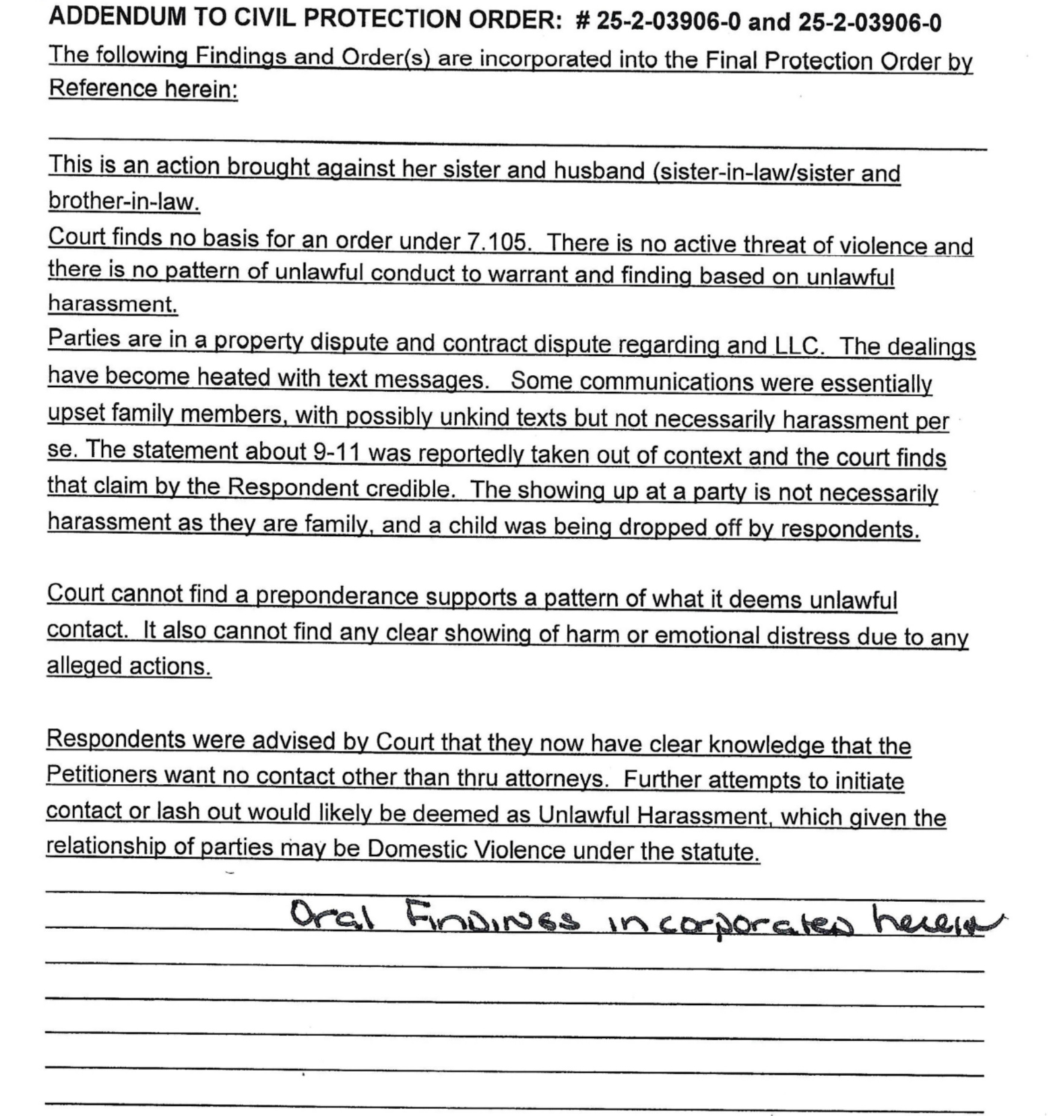
The hostile communications also led to separate protection-order proceedings. On November 4, 2025, full protection orders were not granted. In its oral ruling, the court said the evidence did not establish an ongoing pattern of harassment. It also criticized my communications and warned against further contact. Both the denial and the warning belong in the account. [11]
That proceeding did not decide rent, ownership or the later possession claim.
The property cases ended through the January 29, 2026 settlement. It described the lease as current and valid, changed the required lease payment to an amount equal to the mortgage payment, and provided for mutual releases and dismissal of the cases. It contained no admission of liability. [12]
The ownership action was dismissed with prejudice on February 3, 2026. The unlawful-detainer action was dismissed with prejudice on February 4.
The releases and dismissals resolved claims. They did not amount to a trial establishing either side’s entire historical account.
On July 23, 2026, Annie and I completed the purchase. The recorded deed names us as grantees. We kept Silver Creek operating, and no resident was displaced through the resolution. [13]
The home was secured.
 Enlarge excerpt ↗
The account that remains
The legal resolution did not make the families’ differing accounts identical. This documentary examines the historical record; it does not reopen released claims.
The written leases remain part of that record. So do the no-default provisions.
The additional $1,000 stopped. Other payments continued.
Jun and Aileen carried mortgage exposure. Annie and I committed resources while relying on cooperation to obtain title. The families discussed transfer, disputed the method, pursued financing and failed to close on the 2025 schedule.
Then possession was sought of the property where the care business operated—for the very use identified in the lease.
Read the demand beside the payments. Read the rent clauses beside the no-default acknowledgments. Read the transfer statements beside their conditions—and the proposed financial exit with the people receiving care there in view.
We secured the home. We still want the account examined.
GO DEEPER
Inspect the record behind the account
Selected public records, qualified excerpts and source limits. A screenshot is an excerpt; a reconstruction is an explanation. Neither replaces the full context.
01 Possession complaint
November 24, 2025, case 25-2-13363-5. Parties pp. 1–2; alleged arrears p. 3; $23,406.60 p. 4; requested relief p. 5. Pleading allegations and requests, not findings.
02 October 21 hearing
Source-linked working transcriptions of the ex parte hearing. Allegations and personal perceptions are attributed; not certified transcripts. Jun’s legal-title, tenant, quitclaim-pressure and nonpayment accounts are read beside the transfer messages and continuing payments. The nonpayment passage preserves his qualified fear of retaliation; the October 20 demand is dated separately. Aileen’s business-origin and withdrawal accounts stay together.
03 December 2022 payment exchange
Aileen invokes the three-resident threshold and prior contract; I say January, 60 months and added to rent. Selected public reader; original-language wording controls.
04 Payment record and reconstruction
Selected monthly transfers and derived extra components. Bookkeeping descriptions are our annotations. Payable, void and adjustment entries must not be added as new cash payments.
05 Lease and amendment terms
Commercial lease: fixed rent, care-home use, written amendment and nonwaiver provisions. Separate December amendment and January-dated replacement are distinguished in the documentary and article; the linked complete lease reader contains the replacement.
06 Replacement amendment chronology
September lender request, all parties’ participation, transmitted attachment and later signed variant. Face date, preparation date and actual execution date are different questions.
07 February 20 conditional signing
Four-person export pp. 160–165. The preapproval condition, expired preapproval, pressure and conditional assent remain together. Displayed times are source clocks; timezone not independently established.
08 February 21 direct message
Separate Aileen-to-Annie export, original p. 1, displayed 1:23:25 p.m. The English passage is a working translation of mixed Cebuano/English, not certified. Adjacent exchanges include accusations and litigation concerns.
09 July 18 proposal
Full native Meta message posted by Jun and signed Aileen & Jun. Shared title/mortgage exit objective, express quitclaim refusal, three alternatives, deadline and disputed financial account. The displayed screenshot is a later two-option repost.
10 July and September resolution efforts
July 22 external proposal contemplated a title/financing pathway. The November 4 filed declaration ¶¶11–12 describes a September offer, initial response and time for consideration. No internal legal advice or detailed September draft is reproduced.
11 November 4 ruling and warning
Existing source-linked oral ruling and written disposition. No finding of an ongoing harassment pattern; criticism and prospective contact warning preserved. No adjudication of rent or title.
12 January 29 settlement
Read the valid-lease recital, amended payment obligation, mutual releases and no-admission provision together. Releases resolved claims; later publication does not revive them.
13 Dismissals and completed purchase
Ownership case dismissed February 3; possession case dismissed February 4, 2026. Deed recorded July 23, 2026, number 202607230402. The continued operation and absence of displacement are our firsthand account.
14 November 21 external letter
Asserted equitable-interest claims and urged negotiating a global resolution rather than pursuing possession. Those were legal positions, not ownership findings or an entered stay.
15 November 24 external response
Preserved quoted response displayed 11:47 a.m., after the 9:57 a.m. complaint filing. Mortgage exposure, sale/partition, conditional corporate claims and invitation for a comprehensive proposal remain together. Internal forwarding advice is withheld.
16 Demand stages and arithmetic reconstruction
October 20 letter: $22,605.28, demanded immediately. Later Notice to Cure bears November 10, 2025; the complaint alleges notice November 14. It demands $27,205.28 and warns of a removal lawsuit if payment or vacation does not occur within three days of service. Complaint pp. 3–5: $23,406.60 through November 24 and possession-related relief. No conclusion about notice validity or actual service is made.
Read the October demand → · Read the complaint →
The expanded calculation uses the existing 49-month owner-side payment reconciliation, October 2021–October 2025, with original bank locators retained privately. It reuses completed checks rather than claiming a fresh full-bank audit. The claimants’ original allocation remains unlocated. This page publishes derived amounts, not private statements or account identifiers.
Read the qualified payment comparison → · Read the financial history and source limits →
17 Resident transfer and discharge protections
WAC 388-76-10615 requires the adult family home to attempt reasonable accommodation to avoid a transfer or discharge unless agreed to by the resident, and to provide preparation and orientation for a safe and orderly move. RCW 70.129.110 addresses permitted grounds, written notice, generally 30-day notice with specified exceptions, and safe and orderly transfer or discharge. Official provisions checked November 10, 2026; relevant provisions were effective during the 2025 dispute.
These are care-provider responsibilities. The article does not conclude that AFH use barred property enforcement, that the landlords had identical statutory duties, or that any resident was actually displaced.