THE WORDS · THE EXPLANATION · THE RECORD
The explanation the court actually heard.
The 911 messages were presented as threats. Annie responded that she meant emergency safety advice for her sister and her sister’s child. Her explanation deserves to be read alongside the allegation, the original messages and the court’s actual findings.
Editorial references use Annie. Her recorded self-identification and historical source wording below are preserved as supplied.
NOVEMBER 4, 2025 · ELAPSED 12:30–13:48
“I believe this is misrepresented.”
Their attorney characterized the 911 language as “directly threatening” and “sent to instill fear.” Below is Annie’s complete relevant response, with the court’s interjections and closing acknowledgment.
Audio-checked working transcript—not a certified court transcript. The publication’s author completed the audio check. This publication uses the working transcript; it does not publish the recording. Child identifiers are redacted, an apparent surname transcription error is corrected in brackets, and the transcript’s unintelligible marker is retained. Punctuation follows the working text.
Annie · 12:30–12:50
Um, my name is Annie Rhea Augusto. I am the sister of Aileen Grace Capinpin. I would just like to respond to, um, what [their attorney] said regarding the evidence that Jun [Capinpin] and Aileen sent that involves [child’s name redacted], their [age redacted] daughter. And-
Judge Terri S. Farmer · 12:50–12:52
So are you the, guardian of her?
Annie · 12:53–12:59
Oh, no. The, um, not her. Um, they sent an evidence regarding what we said about [child’s name redacted].
Judge Terri S. Farmer · 13:00–13:00
Oh.
Annie · 13:00–13:28
So, um, which I said, "Yeah, and teach [child’s name redacted] how to call nine one one. Stay safe. " I believe this is misrepresented. I did not mean to cause any harm to [child’s name redacted]. The reason why I said this is because Jun had a history of physical assault towards Aileen, and I can no longer keep my sister safe. So that's why I said, "Teach [child’s name redacted] how to call nine one one.
Judge Terri S. Farmer · 13:31–13:31
[Unintelligible]
Annie · 13:31–13:34
.So Jun’s assault towards Aileen is widely known in the family
Annie · 13:37–13:42
along with his, um, repeated attempts to quote-unquote "Tame Aileen”.
Judge Terri S. Farmer · 13:43–13:43
All
Judge Terri S. Farmer · 13:46–13:47
right. Thank you. Just one minute.
The explanation was about her intended meaning. Annie’s statement about earlier assaults and family knowledge is her allegation and explanation. The court did not adjudicate the truth of those historical allegations. The written denial addendum credited her explanation of the 911 remark; that does not turn every statement in her response into a separate judicial finding.
Original dated 911 entries — HR01 p. 9 · Annie’s written denial and addendum · Complete relevant ruling, criticism, contact warning and responses.
SPOKEN RESPONSE AND WRITTEN CONTEXT
The prepared material was broader than the response heard.
The supplied written rebuttal, B-Goodbye-Forever-911, describes reported prior assaults and explains the 911 reference as a safety precaution. That matches the purpose Annie stated in court. Her reference to family knowledge and “tame Aileen” also appears in the oral response.
The written document includes additional historical details and screenshots. We do not splice them into the hearing transcript or imply the judge heard or accepted all of them. The supplied document is annotated rebuttal material; its status as an executed or filed declaration has not been established by this review.
It also explains “goodbye forever” as an end to a relationship. That is the writers’ explanation, not an independent finding about everyone’s intent. The original exchange contains angry and confrontational language. Restoring context means preserving those words too.
The native-export wording reproduced in HR01 differs from Annie’s spoken recollection: her oral response includes “how to call,” while HR01 reads “Yeah and teach [child name redacted] call 911. Stay safe”. A privately preserved capture also marks her message “Edited.” These are distinct source versions; the available records do not establish the earlier wording, edit time or complete edit history.
Read the preserved dated messages and their source qualification · Our own profanity and its date.
NOVEMBER 2025 · DIFFERENT DOCUMENTS, DIFFERENT EVENTS
A three-day demand. A separate lawsuit. Keep the dates straight.
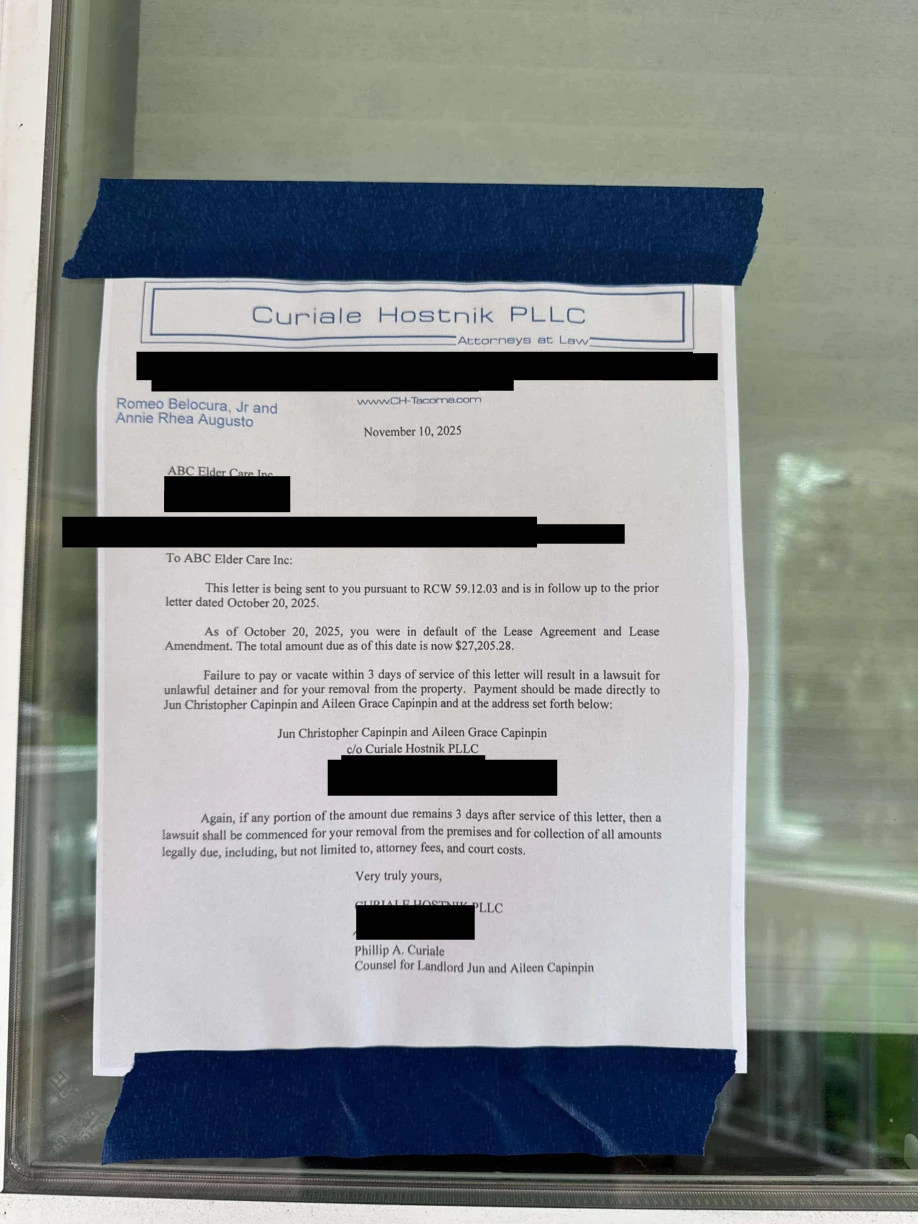
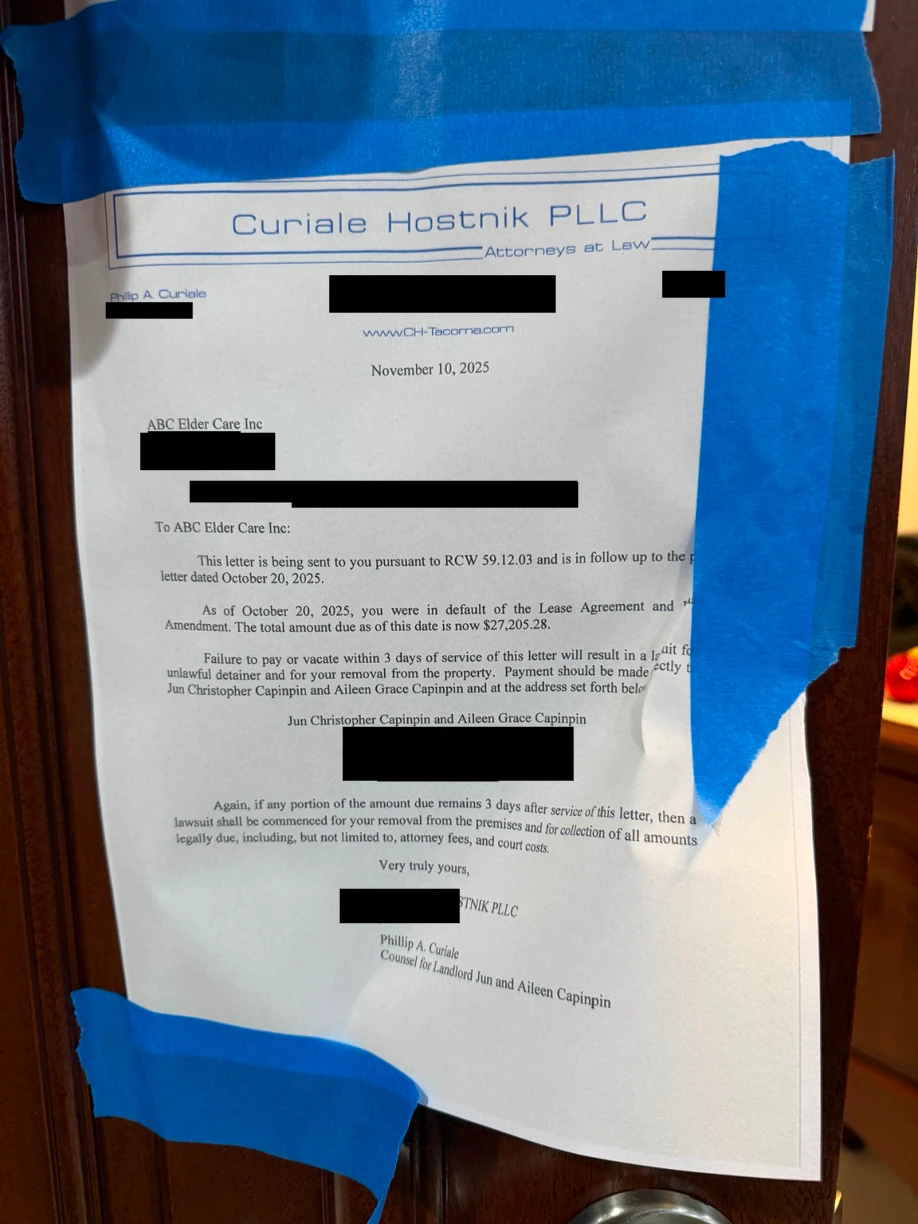
The supplied notice demands $27,205.28 and says failure to “pay or vacate within 3 days of service” will result in an unlawful-detainer lawsuit and removal proceedings. That was a demand over the premises where we operated the care home. It was not a court order establishing the debt or ordering an eviction.
November 10: the date printed on the notice
Both supplied scan copies bear this date. Their filenames refer to November 13 and 14; filenames alone do not establish separate posting dates.
November 14: the complaint’s notice allegation
The November 24 complaint, paragraphs 13–14, identifies November 14 as the date a notice was provided and alleges that a copy was affixed “in two conspicuous places” for unknown occupants. That is their pleaded account, not an independently verified posting log.
November 25: service of the lawsuit papers
The filed returns describe the summons, complaint, case schedule and cover sheet—not service of the earlier cure notice. One describes delivery at the home at 3:57 p.m.; the other describes delivery through ABC’s registered agent at 4:39 p.m. Both were signed November 26 and filed December 5.
Read what the server reported, including the unfavorable context
For the home delivery, the return states: “A female employee refused to accept service per the instructions of her superiors. Therefore, I dropped the packets at her feet.” This is the server’s sworn account. The return labels the method “Abode Service”; this publication does not decide whether service was legally sufficient.
The other return describes hand delivery through ABC’s registered agent. Its recipient is not identified here as the family member discussed elsewhere in this account.
The returns include service-location photographs. They concern November 25 lawsuit service, not photographs of earlier cure notices affixed to the doors or windows.
Romeo and Annie report notices posted on doors/windows over three consecutive days. The exact notice text and the complaint’s allegation of two conspicuous postings are now available. Newly supplied photographs show copies taped to glass and a wooden door, supporting physical posting in those views. Their capture dates are not established. The reviewed folder does not supply a separate November cure-notice posting affidavit establishing all three days, public visibility or documented operational effects. Those points remain their account, rather than a corroborated three-day chronology. See the photographs below.
The demand’s arithmetic can be traced; its starting balance still needs an explanation. Adding $4,600 to the October demand produces $27,205.28. Subtracting our $3,798.68 payment produces the complaint’s $23,406.60 claim. That does not explain the historical months and credits making up the original demand. They never provided us a month-by-month computation; our reconstruction remains explicitly ours. Read the full financial comparison.
Notice and complete service-return pages — privacy-redacted source packet (7 pages) · Complaint paragraphs 13–14 — reader p. 4 · Requested remedies, our separate ownership claim and the negotiated outcome.
The notices photographed in place.
These supplied photographs show notices taped to glass and a wooden door. The letter date is November 10, 2025. That printed date is not a verified photograph or posting date; different views may show the same posting. We do not count photographs as separate service events.
See the photographs of the mounted notices
Open NS02 — posting photographs with source limits (3 pages).
What these records establish
The transcript establishes the explanation Annie gave. The written order records the court’s disposition and stated reasoning. The notice establishes its written demand. The complaint states the plaintiffs’ posting allegation. The returns contain the server’s sworn account of later lawsuit service. Those sources answer different questions.
No hearing audio, privileged client/counsel correspondence, children’s identities or resident information is reproduced. The protection court’s criticism and contact warning remain part of the account. The property cases ended by negotiated settlement and dismissals, not a merits verdict establishing wrongdoing.
← 911 comparison · ← Notice chronology · Sources and corrections